• The forum upgrades have been completed. These were moderate security fixes from our software vendor and it looks like everything is working well. If you see any problems please post in the Forum Technical Support forum or email us at forum_moderator (at) aawforum.org. Thank you
  • It's time to cast your vote in the March 2026 Turning Challenge. (click here for details)
  • Congratulations to Chris Lawrence for "Dragon's Grip" being selected as Turning of the Week for March 30, 2026 (click here for details)
  • Welcome new registering member. Your username must be your real First and Last name (for example: John Doe). "Screen names" and "handles" are not allowed and your registration will be deleted if you don't use your real name. Also, do not use all caps nor all lower case.

Homemade Threading Jig

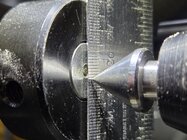
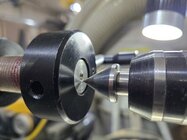
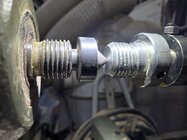
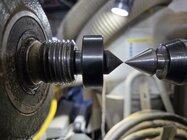
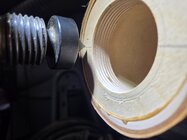
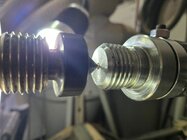
20260117_114317.jpg20260117_113503.jpg20260117_113429.jpg20260117_112142.jpg
The 1st & 2nd pictures show the crank end of the spindle & tailstock how showing how far out of parallel it is to the lathe bed. I lined up the chuck end of jig with the head stock in picture 3.This is mine showing head stock & tail stock alignment in 4th picture. I am not sure if the pictures will come through as I am new here & don't have some permissions yet.
 
This is mine showing head stock & tail stock alignment in 4th picture.
Not to bad… But if you want it closer, you should be able to get a better alignment on most lathes by adjusting the front left leg leveler (tailstock end). I check and adjust every time the lathe is moved. The beds on most lathes will twist if the floor is the least bit uneven.
 
Last edited:
Dwayne, I’ve checked my Hope Jig and mine too isn’t parallel to the bed. Like yours it’s nose down, but in my case by about 2mm. I haven’t checked the Banjo before, but I did today and it’s spot on visually.

As I mentioned I’ve not noticed any issues with actually using mine. The results were fine. I may though look to see if I can correct the issue. Nothing I can do about the welding if that’s the cause, but the “pivot block” screwed to the underside of the body may not be perfectly square? If it is then milling a tiny amount off the top at a slight angle might correct the problem. More likely I’d mill up a new piece of steel though as I have a milling machine.
Obviously you shouldn’t have to do this.

I have more pressing jobs to do though like painting the house - when it stops *raining, so it’s a job for the back burner.

* I read it’s rained every day of 2026 so far in the UK.
 
Not tto bad… But if you want it closer, you should be able to get a better alignment on most lathes by adjusting the front left leg leveler (tailstock end). I check and adjust every time the lathe is moved. The beds on most lathes will twist if the floor is the least bit uneven.
Actually John the lathe is good for alignment as you can see in the last picture. Both live centers in head & tail stocks line up perfect. Also the banjo is right on 90 degrees to the bed.
It is the body that the threading spindle goes into isn't square to the 1" mounting post. That's why when the head stock & spindle in picture 3 line up, the tail stock & crank end of the spindle are out by almost 3mm shown in pictures 1 & 2.
 
Dwayne, I’ve checked my Hope Jig and mine too isn’t parallel to the bed. Like yours it’s nose down, but in my case by about 2mm. I haven’t checked the Banjo before, but I did today and it’s spot on visually.
So it sounds like we have the same problem. I have taken some of mine apart to see how it put together. That is removing the 2 allen screws on the hinge to remove the lower part of the hinge body & 1" mounting stem.
You can then slide them apart. Then I removed the red locking knob screw on the top for the housing for the thread depth adjustment. You can then turn the main cylinder body from the other as it is threaded onto the depth adjustment knob. Those parts are machined very well. next to nothing in play. I didn't remove the big silver depth knob as it have nothing to do with the issue.
The lower part of the body that the hinge is mounted to seems to have a threaded stud that screw into the 1" stem secured with an allen screw at the top of the stem. I tried to take them apart but I think the allen screw has mashed the threads. Being as you have a milling machine you might be able to mill a tapered spacer to put in there. If you can take yours apart.
The other option is making a shim to put under the head stock side of the banjo that will raise that side up attached with a magnet so it holds in place when adjusting & it's easy to remove when done.
Thanks for your input & hope you get yours corrected.
Also good luck with the painting.
As for the weather your having I will gladly live with the snow we get. That many day's of rain I would be in a straight jacket even it was summer.
Thanks again.
 
I had another thought. Sometimes jacking screws are used on equipment for adjustment. Not sure if this is a possibility somewhere on the Hope Jig?

I managed to paint part of the house a while back. This was prompted by us ordering a new car, an EV.
It’s our first EV so we obviously needed to get a charger installed. I wanted to at least paint the house where the charger Is located rather than paint round it!
 
Actually John the lathe is good for alignment as you can see in the last picture. Both live centers in head & tail stocks line up perfect.

Pardon me. The tailstock point in the last picture looks lower than the headstock point. But not much. That much usually doesn't make much difference except for certain things. During a break in a demo I had to adjust our club lathe before Mark StLeger could complete the next critical step.

I didn't read all the posts here but if there is a misalignment problem in the threading jig due to welding, assembly, or part tolerances any machine shop (or hobbyist with the right tools could make it perfect if you wanted.

A mental sketch suggests that even threads cut at with the slightly tilted cutter angle should still work although the threads wouldn't be perfectly symmetrical. For a severe tilt the threads might need to be sloppy. Probably not a show-stopper for the relatively loose, short threading typical on wooden boxes and such. Could verify this with a thread gauge. Threads cut with my Baxter have been well-formed.

Lots of rain here today. Puts halt to my building site prep but doesn't stop me from processing more turning blanks in the shop. I have WAY too much wood. (sigh)

Yikes it must be cold where you live! I made a couple of tech transfer trips to Saskatoon, one in the dead of winter. I thought I was going to die just walking to my host's car. (He stopped at a mall so I could buy some gloves. "What!! You didn't bring gloves???) I did spend a couple of hours in customs on the first trip explaining that, yes, our trip was related to work, but no, we were not coming to take work away from Canadians but sharing ideas and brainstorming variations from our inventions that could bring jobs into Canada!

Even got to make a side trip on the way home to Banff and see the amazing ice sculptures at LakeLouise - something new to me.

JKJ
 
The other option is making a shim

I use three types of shims:
  • One, take apart feeler gauges and find what shim or combination works. The thickness is marked on each piece. Use these when I want steel shims. Keep a bunch of loose ones in a drawer.
  • Have a package of brass shim stock. Larger than feeler gauges.
  • Keep "books" of plastic shim stock - each leaf color coded with the thickness in a printed table. From extremely thin to quite thick. The sheets are large, meant to be cut as needed.
JKJ
 
I use three types of shims:
Thanks for the input. Yes there might be .1mm difference in head & tail stock. I think I will do the shim thing first as it will not alter anything that can't be reversed. Then think about another actual cure for it rather than a band aid.
As for the weather it is crappy now as we have had to many melting days & it makes a mess of everything. Now suppose to get back down to -20c to -30c for a few days. You must have been lucky to hit 1 of the cold snaps in Saskatoon.
If that was your first time to Banff & area I would be an eye opening experience. It is beautiful out there, summer & winter.
I am sure it was not a simple ordeal with customs. Has only gotten worse since Covid.
Thanks again.
 
This is a response to JKJ's request for me to explain the benefit of climb cutting with threading jigs.

Google on "why is a climb cut best in woodworking". the following are my first two responses from Google.

"A climb cut is considered best in woodworking because it generally produces a cleaner, smoother finish with less tear-out, especially when working with difficult grain patterns, as the cutting action is directed "uphill" against the wood fibers, effectively pushing chips away from the cutting edge instead of allowing them to get caught and tear the wood apart; this also results in better control and less likelihood of the workpiece being pulled into the cutter, making it ideal for edge routing and delicate cuts."

"This is because it allows the cutting edges of the bit to engage the wood fibers cleanly, shearing them off as the bit rotates. The pressure is applied in a way that helps prevent tear-out and results in a cleaner, more controlled cut.Dec 15, 2023"

I'm not going to get into arguments over this since climb cutting is widely known and accepted in production woodworking as best for clean cuts especially in softer woods. A threading jig is one of the few ways a climb cut can easily be done without more exotic ways like using CNC machines. Depending on the amount of friction in the jig screw hand pressure might be needed to prevent the jig from self feeding. Most who have experience using hand held wood routers know what happens when you try climb cutting (it's not recommended).

If you don't understand the difference between a climb and conventional cuts use the forum search function. I posted a diagram about the two processes in the past.

Having used climb cuts many times and seeing the benefits, I pretty much subscribe to your philosophy. Here comes the "but". Am I not understanding the google information or do they have it backwards. I think the last sentence in your next to last paragraph is correct. Google said otherwise. What do you think?
 
It sounds like your assumption of the welding being off may be correct. I’ll try to double check mine and see if it’s high or low at the tailstock end. I’ve only cut a couple of box threads - nothing over about 10mm long, and didn’t notice any issues.
I’m guessing it would show up on longer threads though if it’s off too far.
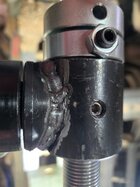
Well Bill, I decided to cut it off, well almost. I cut out all the weld except a little at 1 end. That way it still held together but could twist it to line up the spindle with the 2 live centers. The weld isn't pretty, but it works.
Now rather than being 7+mm off center on 12" long work piece including chuck, it's only roughly .5 mm. Now the height collar on the mounting post will work for any length of work piece & the calculations for threading will work also.
I thought about other possible options but this seemed like the proper fix to me. Just took awhile to get up the courage to start grinding it off. Got some blurry pictures attached below you can open up,,,,, I hope.

UPDATE
Hi Bill.
I don't think you can open these pictures as John said he couldn't.
I sent the same ones again to him & it seems to work.
They are just a few posts down.


View attachment 86768View attachment 86769View attachment 86770View attachment 86771
 
Last edited:
I use three types of shims:
  • One, take apart feeler gauges and find what shim or combination works. The thickness is marked on each piece. Use these when I want steel shims. Keep a bunch of loose ones in a drawer.
  • Have a package of brass shim stock. Larger than feeler gauges.
  • Keep "books" of plastic shim stock - each leaf color coded with the thickness in a printed table. From extremely thin to quite thick. The sheets are large, meant to be cut as needed.
JKJ
Hi John. I got the Hope threader fixed. I explained a little on the post above I sent to John & some attachments with pictures.
Here's 1 more picture of the job I was doing. A Birch piggy bank.

View attachment 86772
 
Dwayne, Good. BTW, your recent picture links don't work for me, report "Something went wrong"

I usually copy/past photos into a message or use the "Insert image" icon (or Ctrl P). Maybe that's an issue.

JKJ
 
Dwayne, Good. BTW, your recent picture links don't work for me, report "Something went wrong"

I usually copy/past photos into a message or use the "Insert image" icon (or Ctrl P). Maybe that's an issue.

JKJ
I was wondering if it would work. Had some issues hope this works. I can only put 3 pictures on here. Will do another with a couple more.
p.s. I am not a welder as you can see.

20260402_144241.jpg20260402_143522.jpg20260402_143455.jpg20260402_143441.jpg

It did it again. Changed the pictures into a file.
Let me know if you can open them before I send more.
Thanks Dwayne
 
Last edited:
John, I think it might have worked this time.
Here is a couple others.
I had thought about the shim idea you mentioned.
But after some I thought about it I decided it would just be a band-aid.
This way it will work on any lathe.

20260402_144306.jpg20260402_135655.jpg
I think if you click on the picture it will expand & be a little bit clearer.

Dwayne.
 
@Dwayne Johre
Your pictures work fine. You can insert up to 4 pictures in a message, or cheat like I do and make a composite with as many photos as you want. This counts as one of the four allowed in a message. More than four?

1775236885793.jpeg
After I place a photo, usually by copying and pasting, I usually click on it and grab a blue corner and reduce the size on the screen to fit better with the message text. Any viewer can click on the reduced photo and see it at a larger size. I made the one I made smaller on purpose.
BTW, when inserting several photos in a row I like to put one or two space characters between them to give a bit of visual separation:

1775237267491.jpeg 1775237177342.jpeg

And I happen to be a weldor: gas, mig, tig, stick, and was a welding inspector for years. How a weld looks has nothing to do with it's function, only it's purpose. The function is defined by it's use and the forces it will be subjected to. For example, on high-pressure piping and vessels for nuclear applications we did not permit things like undercut, porosity, inclusions. For shop devices, even simple tack welds and non-prizewinning beauty welds may suffice.

JKJ
 
Thank John.
Very nice work & thanks for the tips.
One thing, why can't I make the vase with lid expand?
The cursor just stays an arrow & doesn't change to a hand like on the other 2 pictures.

Dwayne.
 
Back
Top