• The forum upgrades have been completed. These were moderate security fixes from our software vendor and it looks like everything is working well. If you see any problems please post in the Forum Technical Support forum or email us at forum_moderator (at) aawforum.org. Thank you
  • February 2026 Turning Challenge: Cookie Jar! (click here for details)
  • Congratulations to Chad Eames for "Red Tines" being selected as Turning of the Week for February 23, 2026 (click here for details)
  • AAW Symposium demonstrators announced - If the 2026 AAW International Woodturning Symposium is not on your calendar, now is the time to register. And there are discounts available if you sign up early, by Feb. 28. Early Bird pricing gives you the best rate for our 40th Anniversary Symposium in Raleigh, North Carolina, June 4–7, 2026. (There are discounts for AAW chapter members too) For more information vist the discussion thread here or the AAW registration page
  • Welcome new registering member. Your username must be your real First and Last name (for example: John Doe). "Screen names" and "handles" are not allowed and your registration will be deleted if you don't use your real name. Also, do not use all caps nor all lower case.

I know this will be controversial.....but, here goes....

Odie

Panning for Montana gold, with Betsy, the mule!
Joined
Dec 22, 2006
Messages
7,711
Likes
13,152
Location
Missoula, MT
I feel very lucky to have learned basic woodturning skills back in the early 1980's. Back then, there was no such thing as a swept back grind.....or, the Ellsworth grind, among other swept back grind shapes attributed to other turners. Back then, all new turners were taught the "traditional" gouge grind. The traditional gouge grind has probably been around for 100 years, and it's something you rarely see these days.....simply because the momentum of the woodturning herd has all but made it extinct.

In my opinion, the traditional grind (if shaped well) is more versatile and can produce a finer cut in difficult places, than any of the swept back grinds.

For those who are unaware of the traditional gouge grind, it's produced using the "V-arm" of the Wolverine jig. The Wolverine makes it easy, but I suppose other turners have made their own simple jigs to produce this grind. It's not complicated, and because of that, it's also very easy to learn.

I suspect there will be a great pushback from the herd here, but this is because the traditional grind is seldom seen anymore.....virtually nobody is teaching it.....and very few turners are using it. Awareness of the traditional grind these days is practically non-existent, except for a few turners who have been turning for close to 40, or more years.

Just to be clear here, I first began using the swept back grind about 35 years ago, during a time when most turners were first learning this new approach to gouge grind shapes. I eventually was using the swept back grind exclusively. Back then, I transitioned from the traditional grind to the swept back grind......prior to transitioning back to the traditional grind about 20 years ago. When I transitioned back to the traditional grind, it was after I had been turning for a couple decades.....so, at that time, I had some experience under my belt to evaluate the usefulness of the various grinds that were available and being taught.

Right now, I don't think I have a single gouge that still has a swept back shape.....and, that Vari-grind jig for the Wolverine is gathering dust! :)

=o=
 
Last edited:
Well, I guess it depends not only when but also where you started. I started turning in the early sixties in Sweden. All gouges were what the British call continental gouges i.e. forged from a flat steel and had a moderate swept back grind. There was no division in bowl gouges and spindle gouges. Looks very much like the spindle gouges I use today. For bowl gouges I today use the now common, milled from round HSS with a swept back grind.

20260223_134024.jpg
 
I feel very lucky to have learned basic woodturning skills back in the early 1980's. Back then, there was no such thing as a swept back grind.....or, the Ellsworth grind, among other swept back grind shapes attributed to other turners. Back then, all new turners were taught the "traditional" gouge grind. The traditional gouge grind has probably been around for 100 years, and it's something you rarely see these days.....simply because the momentum of the woodturning herd has all but made it extinct.

In my opinion, the traditional grind (if shaped well) is a more versatile and can produce a finer cut in difficult places, than any of the swept back grinds.

For those who are unaware of the traditional gouge grind, it's produced using the "V-arm" of the Wolverine jig. The Wolverine makes it easy, but I suppose other turners have made their own simple jigs to produce this grind. It's not complicated, and because of that, it's also very easy to learn.

I suspect there will be a great pushback from the herd here, but this is because the traditional grind is seldom seen anymore.....virtually nobody is teaching it.....and very few turners are using it. Awareness of the traditional grind these days is practically non-existent, except for a few turners who have been turning for close to 40, or more years.

Just to be clear here, I first began using the swept back grind about 35 years ago, during a time when most turners were first learning this new approach to gouge grind shapes. I eventually was using the swept back grind exclusively. Back then, I transitioned from the traditional grind to the swept back grind......prior to transitioning back to the traditional grind about 20 years ago. When I transitioned back the traditional grind, it was after I had been turning for a couple decades.....so, at that time, I had some experience under my belt to evaluate the usefulness of the various grinds that were available and being taught.

Right now, I don't think I have a single gouge that still has a swept back shape.....and, that Vari-grind jig for the Wolverine is gathering dust! :)

=o=
Here's the thing I wonder... any really decent videos on actually doing and using that grind? Most every turner and YouTube video I've watched uses vari-grind jig for sharpening and swears by the swept back grind, but to my recollection I have yet to watch a decent youtube on that traditional grind and its use... so now I wonder if that might be "my" solution , since I'm basically self taught from watching turning videos on Youtube, I don't think I have ever even tried the traditional grind....
 
Here's the thing I wonder... any really decent videos on actually doing and using that grind? Most every turner and YouTube video I've watched uses vari-grind jig for sharpening and swears by the swept back grind, but to my recollection I have yet to watch a decent youtube on that traditional grind and its use... so now I wonder if that might be "my" solution , since I'm basically self taught from watching turning videos on Youtube, I don't think I have ever even tried the traditional grind....

I am not aware of any current instruction on the traditional grind. In my thinking, the transition from traditional grind to sweptback grind has been universal and complete. This transition occurred during a time in the early 90's when most turners didn't have computers yet, and I remember the furious transition where most all woodturners considered the new swept back grind an industry wide innovation.....Including me! When I made the transition, I had been turning for 10 years, or so, and as I look back now, I consider myself not a particularly good turner back then.....even though I thought I was a better turner then, than I do now with my hindsight.

I remember sometime about 20 years ago, I had seen someone's compilation of all the different grinds with photos right here on the AAW forums. It was a well-done reference.......but the traditional grind was completely absent! I commented on this at the time, but the woodturning community was on a fast-track with the thinking that the only grinds that had any value are the swept back grinds.

Howdy Odie, Interesting thoughts on the type of grind. I am wondering if you could take a photo or three of the "traditional grind" to share with us?

I believe I have some photos comparing the two types of grinds.....I'll look, but I have many hundreds of woodturning photos that are not very well organized----->Unfortunately, it's one of those "round tuits" that I've never had! :(

=o=
 
Last edited:
Well, I guess it depends not only when but also where you started. I started turning in the early sixties in Sweden. All gouges were what the British call continental gouges i.e. forged from a flat steel and had a moderate swept back grind. There was no division in bowl gouges and spindle gouges. Looks very much like the spindle gouges I use today. For bowl gouges I today use the now common, milled from round HSS with a swept back grind.

View attachment 85497

True, Lennart.....

As far as that goes, I consider there to be two distinctly different woodturning communities......the USA community, and the international community. Even at that, you might want to break that down into more than one international community, but I do consider the USA community to be a self-contained entity.

=o=
 
I feel very lucky to have learned basic woodturning skills back in the early 1980's. Back then, there was no such thing as a swept back grind.....or, the Ellsworth grind, among other swept back grind shapes attributed to other turners. Back then, all new turners were taught the "traditional" gouge grind. The traditional gouge grind has probably been around for 100 years, and it's something you rarely see these days.....simply because the momentum of the woodturning herd has all but made it extinct.

In my opinion, the traditional grind (if shaped well) is more versatile and can produce a finer cut in difficult places, than any of the swept back grinds.

For those who are unaware of the traditional gouge grind, it's produced using the "V-arm" of the Wolverine jig. The Wolverine makes it easy, but I suppose other turners have made their own simple jigs to produce this grind. It's not complicated, and because of that, it's also very easy to learn.

I suspect there will be a great pushback from the herd here, but this is because the traditional grind is seldom seen anymore.....virtually nobody is teaching it.....and very few turners are using it. Awareness of the traditional grind these days is practically non-existent, except for a few turners who have been turning for close to 40, or more years.

Just to be clear here, I first began using the swept back grind about 35 years ago, during a time when most turners were first learning this new approach to gouge grind shapes. I eventually was using the swept back grind exclusively. Back then, I transitioned from the traditional grind to the swept back grind......prior to transitioning back to the traditional grind about 20 years ago. When I transitioned back to the traditional grind, it was after I had been turning for a couple decades.....so, at that time, I had some experience under my belt to evaluate the usefulness of the various grinds that were available and being taught.

Right now, I don't think I have a single gouge that still has a swept back shape.....and, that Vari-grind jig for the Wolverine is gathering dust! :)

=o=
For myself,
Being a newb and all, that old school grind tends to be easier to control really, that appears to be what a few well known turners use for bowl interiors too, that was all an old friend who was kinda my mentor in a lot of ways in carpentry ever used, scrapers a couple gouges and a parting tool were his arsenal, all ground freehand on a regular old bench grinder with a light touch, nothin fancy but man he could turn out some cool pieces.
 
When some one mentions the "traditional" grind, I think of one where the bevel runs straight across the bottom of the gouge, pretty much no sweep to the bevel at all. Other than that, I don't know. I can't think of how that could be done with the Wolverine set up. As for swept back gouges, not sure how far back they go, but a long time. I haven't used one since I learned platform sharpening, and that may go back 15 years or so. The swept back design is kind of a jack of all trades, but also, a master of none. I use the 40/40 and a variety of BOB tools.

robo hippy
 
I think its maybe horses for courses. I have one gouge square ground as Reed has mentioned roughly at 55' for internal open bowls. I run 40 and 45 on my gouges, but predominately 40.

But I would think it goes back to a time when milling machines either were not around or sufficently designed. A time of the blacksmith.
Heres a previous thread https://www.woodworkforums.com/archive/index.php/t-238520.html
 
When some one mentions the "traditional" grind, I think of one where the bevel runs straight across the bottom of the gouge, pretty much no sweep to the bevel at all. Other than that, I don't know. I can't think of how that could be done with the Wolverine set up. As for swept back gouges, not sure how far back they go, but a long time. I haven't used one since I learned platform sharpening, and that may go back 15 years or so. The swept back design is kind of a jack of all trades, but also, a master of none. I use the 40/40 and a variety of BOB tools.

robo hippy

Howdy Robo.....

What's a "BOB" tool? I doubt there is any popular grind that I don't have some basic knowledge about, but when people use abbreviations, it sometimes doesn't help understanding just what is being discussed. In posts, I normally try to use the full term at least once, so that when the abbreviation is used, the reader has a reference point. Thanks.

I think you have a pretty good idea of what a traditional gouge grind is. What's important, is to get a very slight convex shape to the wings.....not straight across. And yes, it's mostly done on the Vari-grind jig these days, but it's such a simple setup, that it's easily done with a very rudimental homemade jig.

Thanks for commenting....

=o=
 
.

What's a "BOB" tool?

=o=
As I understand it , it is ground at around like a 60 to 70 degrees or so bevel in a grind similar to a SRG is done so it has fairly steep non-swept sides that allow for the cut through the transition, but I also think it is basically a traditional grind since if I understand correctly it is simply ground by rotating the tool in the V-arm - exactly as one might do with a SRG .. So I guess, for me, since my handles and tools are all different lengths from cutting tip, I'd have to re-adjust the one way V-arm every single time for each gouge I work with .. I think thats the beauty of the vari grind jig since you can often just stick with one nose protrusion length and the overall length of the tool does not matter.. but by design the vari grind doesn't really give a traditional grind does it?
 
Turners gravitate to the gouges and grinds that meet their needs and skill level
As mentioned above many turners use a Bottom feeder with a traditional grind
I teach and demo using a traditional grind on a 3/8 diameter bowl gouge for hollowing spheres

Most professional turners moved to the side ground bowl gouge in the mid 1990s because it makes cuts that cannot be made with a traditional bowl gouge.

A few Cuts that the side ground can make
Rough a 3/4 -1” wide shaving with a 5/8 bar gouge
pull cut using the wing - near skew quality surface.
flute up shear cut with the leading edge of the wing
shear scrape with the wing edge
scraping cut with the wing

Professional turners could make bowls faster with a better surface using the cuts above.

I was fortunate to get a class with Liam O’Neil in 1994. Liam had invented the side grind. He found converts in John Jordan, David Ellsworth, and many others. David modified the grind to his signature grind.

In our class Liam mounted a warped dried 12” diameter cherry bowl on a faceplate. He then cut the outside smooth in one pass using a pull cut from foot to rim then shear scraped it. A useful technique and tool for a professional bowl turner.

Trent Bosch uses finishing gouge for bowls with a traditional grind on the right side and an Ellsworth grind on the left side.
The traditional grind does a flute up cut on the outside of the bowl the leading edge makes a near vertical shear angle.
The Ellsworth side does the flute up cut on the inside of a bowl with a very high shear angle.
 
Last edited:
Odie, here is my view. I know about 90% of turners use the Wolverine jig and are happy with it. You commented you get the traditional grind using it, however I don’t think the Wolverine really produces the tradition grind of 100 years ago. To me replicating the Wolverine by hand would not be natural. I would call the grind a “modified” traditional grind, close, but no cigar! I use the Hannes Vector Jig and my opinion it it produces a much closer representation of the traditional grind of 100 years ago. It would be a much better hand movement replication how the Vector Jig grinds,
 
Howdy Odie, Interesting thoughts on the type of grind. I am wondering if you could take a photo or three of the "traditional grind" to share with us?

I looked and could not find the photos I was looking for, so I took some new photos.

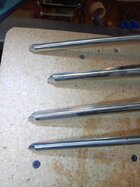
On the traditional grind, the length of the bevel can vary according to the current need, and it's extremely easy to do minor adjustments. I normally hone the very tip of the cutting edge, and if you look closely, you can see that the bottom gouge has been re-honed several times. I don't need to return to the grinder for maybe 4-5 times that I re-sharpen....just a few strokes of a flat diamond hone for the outside, and a cone shaped diamond hone removes the burr in the flute. This quickly brings the edge back to life.

Here are a few of my current gouges with traditional grinds:
20260223_185124.jpg

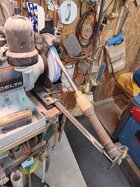
The traditional grind uses the Wolverine V-arm, and is rotated longitudinally to shape the wings and nose.
It's done like this:
20260224_072923.jpg

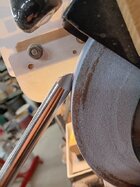
Setups are much much easier, because you don't need any of those specialized tools to find the proper angle....or that cumbersome Vari-grind jig. All you should be interested in, is matching the current existing bevel. Note: I don't even know for sure what angle the bevel is, because knowing that isn't necessary at all! All I do is use a white backer and look from the side. You can easily see how the bevel matches the wheel.....and, you can do it perfectly in seconds! In this photo, you can see a little gap between the wheel and the gouge tip. This is what you want if your intent is to create a slightly longer bevel. You can create a slightly shorter bevel for BOB applications very easily by just allowing a little gap at the heel of the bevel. (You can also see along the edge where I've re-honed this gouge several times since it was last trued up on the grinder. This one is about ready to regrind again.)
20260224_073034.jpg

Odie, here is my view. I know about 90% of turners use the Wolverine jig and are happy with it. You commented you get the traditional grind using it, however I don’t think the Wolverine really produces the tradition grind of 100 years ago. To me replicating the Wolverine by hand would not be natural. I would call the grind a “modified” traditional grind, close, but no cigar! I use the Hannes Vector Jig and my opinion it it produces a much closer representation of the traditional grind of 100 years ago. It would be a much better hand movement replication how the Vector Jig grinds,

Hi Bill......:)

Who cares!

You can refer to it as the "odie grind" if you'd like. :)

=o=
 
Last edited:
Hi Bill......:)

Who cares!

You can refer to it as the "odie grind" if you'd like. :)

=o=
Hi Odie

I’m sure someone cares if not you!🫠

Just making a point that IMO the Vector Jig produces the best grind for me and your grind is not the only grind that is the best. I used the
wolverine for many years and IMO the Vector Jig is better IMO.
 
Hi Odie

I’m sure someone cares if not you!🫠

Just making a point that IMO the Vector Jig produces the best grind for me and your grind is not the only grind that is the best. I used the
wolverine for many years and IMO the Vector Jig is better IMO.

Of course, Bill.......

That's why I put this thread in the "getting started" forum.

I know very well that seasoned turners like you are already set in their ways, and difficult to influence.

The newbies are much more open minded about things that are not a part of "herd think", and so firmly established.

Even so, I think there might be a few seasoned turners who will consider trying the traditional grind.


=o=
 
Well, some one beat me to it.... Bottom of Bowl. I thought when I coined that phrase that "bottom feeder" was a signature tool. I grind mine at the 70 degree setting on my grinder platform, which is actually 65 degrees, and the nose is ) shapes, so minimal sweep. Thinking about it, the "traditional grind is more of a roll with no sweeping of the handle to the sides. I have never tried it. I do like a bit of sweep in all of my tools. My favorite BOB tool is a spindle detail gouge. The advantage to it with the minimal sweep is that when you roll it on its side, you get a very high shear angle for cleaner cuts. I frequently have mine at 60 or more degrees.

robo hippy
 
Back
Top