• January 2026 Turning Challenge: Turned and Bent! (click here for details)
  • Congratulations to Phil Hamel, People's Choice in the December 2025 Turning Challenge (click here for details)
  • Congratulations to Ric Taylor for "Black Ash Burl" being selected as Turning of the Week for January 26, 2026 (click here for details)
  • Welcome new registering member. Your username must be your real First and Last name (for example: John Doe). "Screen names" and "handles" are not allowed and your registration will be deleted if you don't use your real name. Also, do not use all caps nor all lower case.

Looking for input from those mechanical/engineering minds

You don’t need a powered solution at all. Instead, glue a portion of a wide sanding belt to a flat substrate to make a sanding slab, then turn your partial vessel upside-down and move it around by hand. A few swipes will even out high spots quickly.

Tim
 
Think vertical lathe. Build a potters wheel. Small motor to keep weight down, pulleys to step speed down, and a shaft that will accept a chuck.

Or find a cheap used lathe and pull the headstock to create the potters wheel.
 
An actual potter's wheel might work nicely - they are almost always variable speed and should be enough torque. A pro potter friend uses multiple wheels. Might find an inexpensive on on Facebook, etc or from a retiring potter or potter heir. It should be easy to mount any kind of a spindle adapter or even a simple threaded rod to hold the chuck.

The problem with a repurposed potter's wheel might be access to the work since the wheels often have wide, round trays. But with the motor and speed control it should be trivial to adapt it to provide clearance for any sanding need.

JKJ
 
Howdy Jim, An interesting dilemma. I know you said you do not have room for another lathe but what about locating a used small mini lathe and removing the headstock? The headstock could be mounted on a bench or a small platform similar to Paul's great idea above. Rotisserie motors pop into my mind (for assembling a finishing station) but they usually go much slower than the 250 rpm you would like. Best of luck!
 
I would say skip the motor drive and the sandpaper.
Mount a shaft with the 1-1/4" adaptor on bearings and put a large handwheel on the outboard end.
Make a flat bed out of something like MDF add an adjustable stop at 90 degrees to the spindle.
Mount a router on a fixture like is used often used to detail turnings (John Lucas could provide photos).
The cut would not need to be very deep and if not deep enough it should be evident how much more is necessary and not more than about .020".
Your left hand on the handwheel and your right-hand moving the router against the stop guide.
The 2 most important considerations are no runout on the spindle and the 90 degree stop guide.
 
I just sketched it up, pencil and ruler technology and had a local machine shop make it.
I have an old Jet 1221 collecting dust, so I thought I'd give this a try since it is small. I can't even find a machine shop close to me that is still open. Everyone closed down!
Did your handwheel have an internal reversed thread or just slide on?
 
I have an old Jet 1221 collecting dust, so I thought I'd give this a try since it is small. I can't even find a machine shop close to me that is still open. Everyone closed down!
Did your handwheel have an internal reversed thread or just slide on?
I just looked at an old Jet 1221 that’s sitting in my garage. It looks like it would be possible to unbolt the headstock and turn it around. Don’t know if the pulleys would line up or if that would be easy to fix. Also would have to reverse one set of pulleys to maintain the ability to change speeds.
 
I just looked at an old Jet 1221 that’s sitting in my garage. It looks like it would be possible to unbolt the headstock and turn it around. Don’t know if the pulleys would line up or if that would be easy to fix. Also would have to reverse one set of pulleys to maintain the ability to change speeds.
Yea I saw that also. However the holes for the shaft / spindle are different sizes for the handwheel and spindle.
I stopped looking after that.
 
I have an old Jet 1221 collecting dust, so I thought I'd give this a try since it is small. I can't even find a machine shop close to me that is still open. Everyone closed down!
Did your handwheel have an internal reversed thread or just slide on?
It does have an internal reverse thread and a couple of grub screws to lock it on. It actually sets the shaft endplay on this lathe too - it's a delta lathe.
I forgot to have him drill a center hole, which is annoying - so I can't tap tapers out of the headstock, doh. I'm not sure what he made it from but it's harder than any drill bits I have.
 
Yea I saw that also. However the holes for the shaft / spindle are different sizes for the handwheel and spindle.
I stopped looking after that.
Not sure what holes you are talking about. Once you turn the headstock around the spindle is on the outboard side. Just mount your faceplate (with a grub screw!) and Bob’s your uncle.
 
This thread is a bit confusing. You want a device to spin your pieces in order to sand the tops of the segmented open rings as you stack them up, but you don't want a lathe (for lack of space?). Now you want to mount your faceplate on the outboard side of a mini lathe (outboard because your forms are >12"?). How about this; cut the ways off your mini lathe with a torch or grinder and spin your work inboard, with a spindle adapter if necessary.
 
Last edited:
Not sure what holes you are talking about. Once you turn the headstock around the spindle is on the outboard side. Just mount your faceplate (with a grub screw!) and Bob’s your uncle.
Thought you were talking about just turning the spindle around.
Not too worried about adjusting speed as long as I can get around 250 rpms
 
I can't even find a machine shop close to me that is still open. Everyone closed down!

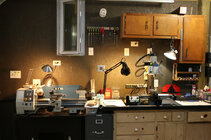
If you are a member of a woodturning club you might ask at a meeting. I know several who, like me, turn wood who also a small machine shop, lathe and mill. Working with wood and metals are both addictive and useful past-times. It does take up a bit of extra space but perhaps less than one might think.

I put mine along a wall in the back room along with some nearly free used kitchen cabinets. Keep metal stock on hand for when the mood, er, the need strikes.
1769555661486.jpeg

JKJ
 
Back
Top