• December 2025 Turning Challenge: Single Tree! (click here for details)
  • Congratulations to Bob Henrickson, People's Choice in the November 2025 Turning Challenge (click here for details)
  • Congratulations to Dave Roberts for "Low Rider" being selected as Turning of the Week for December 1, 2025 (click here for details)
  • Welcome new registering member. Your username must be your real First and Last name (for example: John Doe). "Screen names" and "handles" are not allowed and your registration will be deleted if you don't use your real name. Also, do not use all caps nor all lower case.

nova ornamental turner

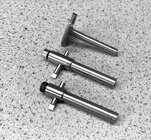
These are some of my tools. The top one is a commercial router cutter, the other two shop made.

IMG_9723.jpeg

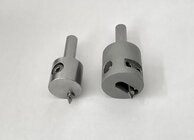
For work on the end. One fixed, one adjustable.

IMG_0451.jpeg

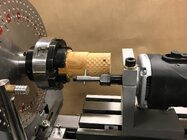
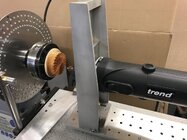
Mounted cutter with safety shield removed for clarity.

IMG_8225.jpeg
 
It’s been suggested that some lathes don’t run fast enough to give a clean cut. Obviously depends on the model of lathe.

Conversely, some routers (if it’s done this way) run a bit too fast. You can get machines with what I believe to be an ideal (adjustable) speed range but they aren’t cheap. I was lucky enough to be able to slow down the lowest speed on my router by adjusting the potentiometer inside. It doesn’t appear to have affected the highest speed which is handy.

If you have, or can get access to a metal lathe the tools are easy enough to make using small pieces of HSS for the cutters.
 
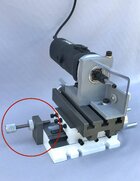
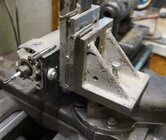
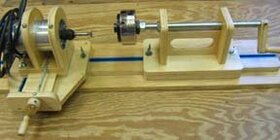
I looked at these type of things a couple of years back. I ended up cobbling this together.

View attachment 76212

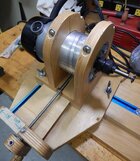
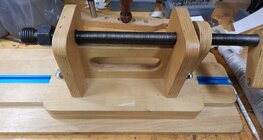
It’s a small standard X Y Table from eBay for which I machined a custom Router mount. I reduced the speed on the router and I’ve made some of my own cutters using small HSS tool bits.

The overall setup obviously moves the cutter from the lathe headstock to the router and the workpiece to the headstock compared to that in the original post above. The setup worked well in tests but I’ve not got round to using it yet apart from that. These type of things work best with dense timbers which aren’t always easy to source at a good price.

What prompted you to add the plexiglass screen, and what has been your experience with it so far?
 
I made the Polycarbonate screen for safety reasons. It would not be difficult to inadvertently touch any moving parts. Also, should a cutter come lose …

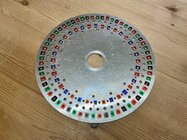
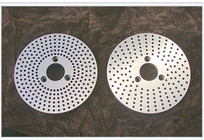
The setup works very well. I did contemplate copying the JaHo but I had concerns with the use of a rotary table. Whilst an RT offers greater flexibility with the number of divisions available I just didn’t think it necessary. I believed, and still do that an indexing plate offered a much simpler, easier and cheaper solution. It’s also very easy to pre mark the plate to avoid making indexing mistakes. This is mine, it looks messy but is easy to use. Once you’ve chosen the spacing it’s just a matter of dropping the detent pin in the relevant coloured hole.

IMG_6578.jpeg

The biggest issue for me has been sourcing dense timbers to get nice crisp cuts. Boxwood and African Blackwood are expensive over here. I have been meaning to experiment using wood hardener on other timbers but I’ve not got round to it yet.

 
I watched the video of the JaHo in action several times. There was a lot of twiddling dials for the position and depth of cut.
I wanted something easier and more repeatable. An indexing plate solved one issue and a depth stop added to the table dealt with the other. Circled in red here.

IMG_8318.jpeg
 
Open question to all that are either using a Nova Ornamental turner or the JaHo adaption such as I am currently finishing up. Everything is now complete on my unit and I now need cutting tools. My boring bar takes a 5/16" diameter rod and since I can't seem to find any premade it's off to the grinder I go. I currently for years have been using my MDF unit and that has a fly cutter. I'm now learning that when I grind my cutter, upon finishing, the point of the cutter must be on center. Since I'm sharpening by hand I find this a little difficult to do an exact job. I'm looking for some tips or pointers on how to achieve a better and more accurate grind in order to keep the tolerances where they should be. Thanks in advance.......... Any and all ideas are very much welcomed.
 
I made the Polycarbonate screen for safety reasons. It would not be difficult to inadvertently touch any moving parts. Also, should a cutter come lose …

The setup works very well. I did contemplate copying the JaHo but I had concerns with the use of a rotary table. Whilst an RT offers greater flexibility with the number of divisions available I just didn’t think it necessary. I believed, and still do that an indexing plate offered a much simpler, easier and cheaper solution. It’s also very easy to pre mark the plate to avoid making indexing mistakes. This is mine, it looks messy but is easy to use. Once you’ve chosen the spacing it’s just a matter of dropping the detent pin in the relevant coloured hole.

View attachment 82066

The biggest issue for me has been sourcing dense timbers to get nice crisp cuts. Boxwood and African Blackwood are expensive over here. I have been meaning to experiment using wood hardener on other timbers but I’ve not got round to it yet.

Good point here Bill. I invested in the Rotary Table only because everyone said I needed to keep track of the indexing, but then again, that's what an "index" plate is suppose to do. Much easier on the eyes rather than constantly setting and changing micrometer dial reading as found on the Roatary Tables. I'm not sure what the color codes are for on your wheel, but your idea is definitely worth some consideration. Please let me know how this works out in the long run. Attaching below my table that I go by to set my Rotary Table to the correnct number of spaces. Assume your index plate works the same???
 

Attachments

  • Degree Rotation Table.jpg
    Degree Rotation Table.jpg
    36.2 KB · Views: 6
Open question to all that are either using a Nova Ornamental turner or the JaHo adaption such as I am currently finishing up. Everything is now complete on my unit and I now need cutting tools. My boring bar takes a 5/16" diameter rod and since I can't seem to find any premade it's off to the grinder I go. I currently for years have been using my MDF unit and that has a fly cutter. I'm now learning that when I grind my cutter, upon finishing, the point of the cutter must be on center. Since I'm sharpening by hand I find this a little difficult to do an exact job. I'm looking for some tips or pointers on how to achieve a better and more accurate grind in order to keep the tolerances where they should be. Thanks in advance.......... Any and all ideas are very much welcomed.

I don’t use either machine, but I do use rod style fly cutters with my rose engine. I documented the sharpening process I use on the Sharpening Handbook (https://sharpeninghandbook.info/WW-RoseEngineFlyCutter-Rod.html).

You can also look at Alibaba / AliExpress to buy them pre-sharpened. They are often listed as engraving bits. The last ones I purchased are these which have 6mm shafts.

The ones I purchased are quite good quality and very sharp.

A 5/16” shaft is 7.94 mm, so 8 mm shafts may work as the difference is 0.00246” (though I’m not sure).

I like that it is easy to find differing cutting edge angles, from 30° up to 120°, though the delivery is a couple of weeks.
 

Attachments

  • IMG_2093.jpeg
    IMG_2093.jpeg
    65.7 KB · Views: 2
Last edited:
As a hobby machinist as well as a wood turner, it’s quite handy to be able to accurately sharpen cutting tools.
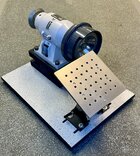
Specialist equipment can be very expensive though so I cobbled this together from a cheap (£30) 6” grinder and a shop made platform. I can mount a variety of different 4” diamond discs to it. I’ve also a growing list of jigs for holding different tools.

You could use almost any grinder. The important part is a fully adjustable rest, plus shop made jigs.

IMG_6689.jpeg
 
Back
Top