• January 2026 Turning Challenge: Turned and Bent! (click here for details)
  • Congratulations to Phil Hamel, People's Choice in the December 2025 Turning Challenge (click here for details)
  • Congratulations to Ric Taylor for "Black Ash Burl" being selected as Turning of the Week for January 26, 2026 (click here for details)
  • Welcome new registering member. Your username must be your real First and Last name (for example: John Doe). "Screen names" and "handles" are not allowed and your registration will be deleted if you don't use your real name. Also, do not use all caps nor all lower case.

Preferred thread size for 2-3” boxes

Joined
Feb 25, 2025
Messages
596
Likes
746
Location
Jackson, MS
I would like to give it a try at threaded boxes. What would be your preferred thread size?

 
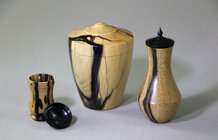
I used 16tpi on the Baxter Thread Master for the Ebony boxes in the picture.

1767118107651.jpeg

I also have 12tpi, 16tpi, and 20tpi hand thread chasers. 20tpi is almost too fine. 12tpi is pretty coarse, ok for larger things.

Some things about threaded boxes
  • It's sometimes better to use fewer threads than more. It's nicer to twist a lid on with 2 turns than with 6.
  • Hard, strong, fine-grained wood cuts cleaner than some softer and coarser grained wood.
  • It can be tricky to calculate the diameters.
  • Threading end-grain boxes is recommended. And from very dry wood.
  • A different wood for the lid eliminates the effort of perfectly aligning the figure.
  • If chasing threads, Mark StLeger recommended practicing on PVC pipe. Mark hand chases hollowed halves to make a clever baseball box. https://s3.amazonaws.com/cmwt.production/paperclip/files/145/StLeger.pdf?1328369689
JKJ
 
I use 16 mostly fir bixes upnton2 1/2" orv3". I have courser threads i use on larger boxes. Allows me to make a looser thread to compensate for wood movement. 20 tpi is used on boxes ear rings under 1".
 
For a 1/4" threaded hole I have 24 tpi for my Baxter threaders. I have yet to try one of that size but do have the tooling to do so. My normal thread is 16 tpi but I do have 8", 10" and a few others for the Baxter Threaders.
 
Most wood turners seem to prefer 16 tpi threads. They look “prettier” than a say a 10 or 12 tpi thread. However I made two boxes one with 16 tpi and one 10 tpi. My wife didn’t like the 16 tpi saying it took too many turns to open. That of course is just one opinion. 10 tpi threads would be more robust in softer wood in my opinion. You didn’t say if you were considering a threading jig or hand chasing. I tried hand chasing and wasn’t successful most of the time and you need wood with a high hardness. 16 tpi threads are a little easer to hand chase than 12 tpi threads as the feed is not as fast. I made a threading jig (posted in the project forum) what I did. You can user soft or hard woods using a jig. I have been successful every time using my jig. I can do 8,10, and 16 tpi. Mostly I do 10 tpi as these threads seem to work well. Alan Batty’s video is a good resource and I use his sizing method for my threads.

View: https://www.youtube.com/watch?v=-0iEd0kD0S4&t=1363s
 
Last edited:
The advantage to the 16 tpi threaders is that when you are getting the grain to line up, you have to remove at most 1/16 inch of shoulder on the base. At least I always adjust the bottom of the box rather than the top. I don't make them more than about 1 1/2 inch diameter, mostly because there is the possibility of wood movement and not being able to get the lid off. One thing you can do, well should ALWAYS do is rough turn them first and let them sit for a month or six before you finish turn them. All woods "adjust" to having bulk removed....

robo hippy
 
One thing you can do, well should ALWAYS do is rough turn them first and let them sit for a month or six before you finish turn them. All woods "adjust" to having bulk removed....

The last part, "all woods adjust to having bulk removed" reminds me of the advice which I always follow - even when finish turning a well-dried roughed end-grain box I ALWAYS turn it almost the finial size then leave it in the chuck at least overnight, maybe longer, before truing up any stress relief movement in the wood, hopefully the last. It's not always there but I can often feel and see it.

Can't remember where I first heard this. From Raffan?

I do it for other turnings too. It sometimes amazes me how much internal stress can be in dry wood. Mounted a dry blank once and did the initial outside shaping. From the sharpening station I heard a loud "crack!" as the wood split from released stress. Even dry spindles blanks can harbor evil stresses - I encountered this earlier this week in a 14" spindle blank just over 1" square - showed itself overnight.

JKJ
 
I do tend to think that kiln dried woods have far more stress in them than air, vacuum kiln, or solar kiln woods have. Rip an air dried piece of wood on your table saw and you get shavings, same with vacuum and solar kiln dried wood. Kiln/kill dried wood, well, you get dust.

robo hippy
 
I use 16 tpi up to 2 to 2 1/2", and 10 tpi for larger. For 16 tpi I add .040" to the tenon and .070" for 10 tpi. This ensures there's sufficient clearance for wood movement. I've lost count (over 200) of the number of threaded boxes I've done and this has always worked for me.
 
Sometimes a little CA is used on the threads near completion on softer woods. Curiosity has me asking if using some thin on the area to be threaded before starting the chasing would be a good idea.
 
When I built my threading jig years ago I found a very coarse thread like 4 tpi was a favorite with users. Just a turn or two to remove the top. Coarse threads can have a great deal more looseness to accommodate seasonal changes in fit.

Grain matching between base and lid was something I didn't care much about. Too much trouble having to be careful getting the lid just at the right tightness or looseness to grain match. Better IMO to use different woods or embellishment at the contact area to avoid the mismatched grain appearance.

I don't know why commercially made threading jigs only offer finer threads. Unscrewing a fine thread with many turns can drive you crazy although somebody told me it can increase the anticipation of what treasure might be in the box once the lid is off.
 
Sometimes a little CA is used on the threads near completion on softer woods. Curiosity has me asking if using some thin on the area to be threaded before starting the chasing would be a good idea.

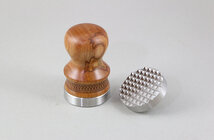
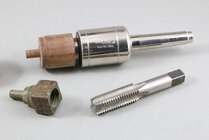
I haven't done that, but I do often use thin CA glue to strengthen wood fibers when threading the outside of a cylinder with a die or threading a drilled hole with a tap, sort of the same idea. Drill/turn hole or cylinder, add thin CA to the wood surface, tap, maybe add more CA then run tap again.

But it doesn't make much difference for hard, strong, fine-grained exotics like this Pink Flamewood:
1767373745057.jpeg
That said, the CA doesn't matter too much for things like bottle stoppers since after tapping the wood I epoxy the stainless steel threads to the wood.

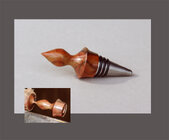
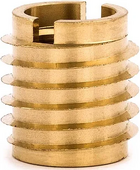
For hardware with fine threads that need to removed often, for example for cleaning or to swap with other hardware, I generally use brass inserts that cut into the wood.

1767375185350.jpeg 1767375422123.png

I find the CA is especially helpful with softer wood or wood with coarser grain to keep the tips of the threads from crumbling, especially with coarse wood threads for like things threaded for the 1-1/4"x8 lathe spindle and custom wooden adapters to fit the 3/4"x10 Oneway-type live centers.

1767374206587.jpeg

JKJ
 
When I built my threading jig years ago I found a very coarse thread like 4 tpi was a favorite with users. Just a turn or two to remove the top. Coarse threads can have a great deal more looseness to accommodate seasonal changes in fit.

Grain matching between base and lid was something I didn't care much about. Too much trouble having to be careful getting the lid just at the right tightness or looseness to grain match. Better IMO to use different woods or embellishment at the contact area to avoid the mismatched grain appearance.

I don't know why commercially made threading jigs only offer finer threads. Unscrewing a fine thread with many turns can drive you crazy although somebody told me it can increase the anticipation of what treasure might be in the box once the lid is off.
Eyeballing peanut butter jars, it seems they are in the 4-6 tpi range. I find them near optimum for ease of use.
 
Eyeballing peanut butter jars, it seems they are in the 4-6 tpi range. I find them near optimum for ease of use.
I agree with Michael. There's no reason other than tradition to use standard 60 degree vee threads.

Here's one of my bottle threads. They're the ultimate in threads IMO. This one is single turn. Use a cutter as shown the get the thread profile.

Bottle threads 2.jpg

bottle 2.jpg
 
I have never had a complaint about 16 tpi being used. I usually see a twinkle in the persons eye when they are unscrewing wood, like who knew you could do this.
 
I'm with you Bill. Everyone who buys my threaded boxes loves the feel and never complained about the number of turns it takes to remove the lid.
 
I haven’t made very many threaded boxes. I can say my wife did not like the number of turns on the 16 tpi boxes I made. However that is only one opinion. My own approach is 16 tpi under 2”, 10 tpi under 3 1/2” and 8 tpi over 3 1/2”. My preference is 10 tpi as that is the size I usually make.
 
Sometimes a little CA is used on the threads near completion on softer woods. Curiosity has me asking if using some thin on the area to be threaded before starting the chasing would be a good idea.
For soft woods I usually start using CA. Hard woods I use it as I am threading. Are you going to do hand chasing or use a jig?
 
Sometimes a little CA is used on the threads near completion on softer woods. Curiosity has me asking if using some thin on the area to be threaded before starting the chasing would be a good idea.
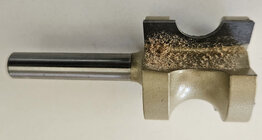
On really soft woods like this urn made from eastern white pine I first put a liberal coat of thin CA on the bore, then when there is still a flat on the thead I apply more CA and finish cutting the thread. Often I will put a coat of CA on the finished thread and without changing the depth run the router bit through for a smoother thread.
IMG_1704.jpg
 
Last edited:
I apply thin CA about the same as Don. Softer woods more CA. If you are hand chasing, best to start with hard woods than relying on the CA to harden it. Hand chasing threads takes practice. I can “almost” do it. Using a jig it is much easier to thread soft wood. With a jig I am successful 99% of the time hard or soft wood.
 
Back
Top