• It's time to cast your vote in the January 2026 Turning Challenge. (click here for details)
  • Congratulations to Ric Taylor for "Black Ash Burl" being selected as Turning of the Week for January 26, 2026 (click here for details)
  • Welcome new registering member. Your username must be your real First and Last name (for example: John Doe). "Screen names" and "handles" are not allowed and your registration will be deleted if you don't use your real name. Also, do not use all caps nor all lower case.

What’s on your lathe?

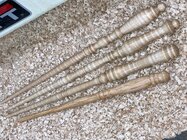
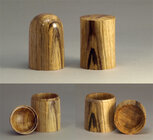
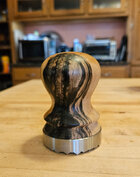
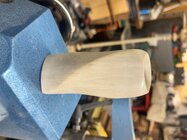
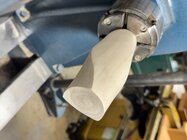
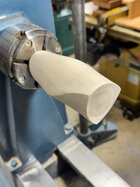
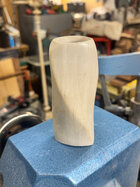
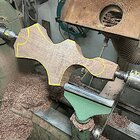
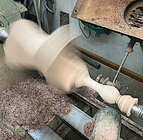
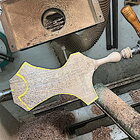
Well, maybe not on my lathe...but fresh off of the lathe is close enough. Four Magic Wands, three of
Curly Maple and one of recycled IDunno Wood. All finished with a rubbed-in wipe on poly.
Oh, and let's not forget all those woodchips that were not stuck to my socks.
 

Attachments

  • Magic-Wands-Jan-2026.jpg
    Magic-Wands-Jan-2026.jpg
    574.8 KB · Views: 41
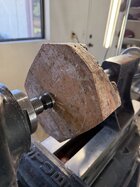
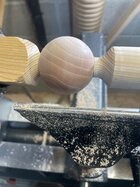
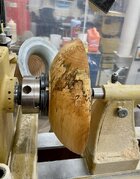
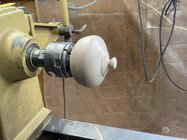
I’m on a journey to turn a true sphere. Plenty of guidance on u tube, but not so smooth in person. This is 2 inches diameter. Started as 2 1/4. Crabapple.

Good fun! It looks like you're well on the way to a perfect sphere!

Mark StLeger showed a nice trick to help refine the sphere. He cut a short piece of what looked like PVC pipe straight across at exactly 90 deg and smoothed the end. Seems like the pipe was maybe 1/2 the diameter of the sphere.

When at the stage of holding it on different axes with cup centers to refine the curves, as it looks like you are in the photo, he holds the end of the plastic pipe against the wood and moves it around on the surface to see where it needs work. When the pipe fits perfectly all over, it's done!

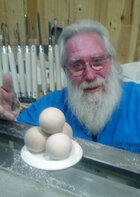
He turned these in a demo at a symposium, turned a round track in a piece of Corian so three spheres fit perfectly. When the top one is spun, all four go round and round! I'm honored to have this one in my display cabinet:

1769651866302.jpeg

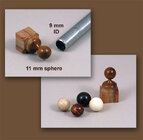
Many years ago I devised kind of a variation of the pipe check method, not to check, but to turn some spheres. I used a piece of steel pipe a little smaller than my intended sphere. Spun the blank on the lathe while swinging the pipe back and forth on the tool rest, sort of like a circular scraper. It quickly transformed the cylindrical blank into one with a marble-sized sphere on the end. It was so easy it almost felt like cheating!

1769652398666.jpeg

When turning larger spheres I start with the octagon method like you probably did, then successively trim off the "corners", approximate the curve with a spindle gouge, then hold between the cup centers to refine.

JKJ
 
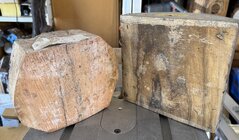
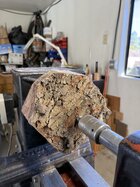
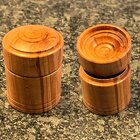
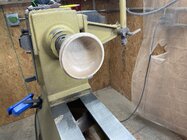
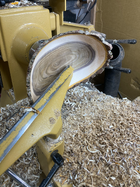
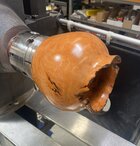
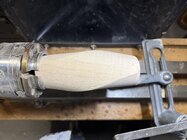
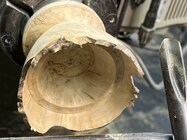
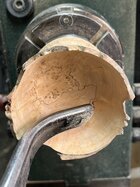
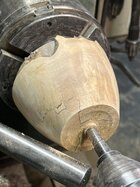
During the 2025 AAW Forum Holiday Swap, Don Frank and I agreed to swap some wood. Don sent me a Cherry Burl and a Persimmon. I decided to turn the Cherry Burl first because Don said the Persimmon might be a little wet.

View attachment 84606View attachment 84607View attachment 84608
Jay, It's good to see you have some of it on the lathe. I haven't done anything with the pieces you sent yet. I'd rough out the persimmon with the idea of twice turning it. Otherwise it might be a while before it gets completely dry. In the meantime your shop will smell good with the cherry burl.
 
Don, I will follow your advice on the Persimmon.
The Cherry Burl does smell great. However, it is proving to be a very challenging piece to turn. Sharp tools are a must.

Be advised that wet persimmon is one of the most warping wood I've had, almost as bad as green holly. I've had boards from the sawmill twist and crook until they were unusable except for small things. Dry persimmon is fine. (Persimmon is wonderful wood to turn - hard, fine-grained, cuts lie glass). BTW, it's a species of ebony)

I cut up some more wet persimmon on the bandsaw recently. I seal well with Anchorseal, sometimes on all sides (depending) and let it dry for at leaast a while or until totally dry until I use it. Even square blanks warp significantly as they dry, depending on where they are cut in the log and how and where the rings cross..

Persimmon is best cut in the winter to help keep it white. If cut when warm, it will often quickly develop brown/grey streaks which don't look bad.

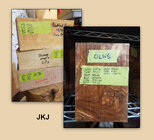
These are persommon:
1769713802932.jpeg

Unlike black ebony, persimmon usually has just a pencil-thin streak of black in the middle, sometime more like one of those boxes. Occasionally I'll find wood like this. When I do, I hide it from woodturners:

1769713919322.jpeg


JKJ
 
Last edited:
It is a beautiful piece of Persimmon and I have more than enough wood to keep me occupied for sometime. The piece is flat on one side and sealed well. Right now I’m battling a California winter with temperatures dropping to the high 50s and low 60s. In a few months summer will provide kiln temperatures for the garage. I can wait until it has had a chance to dry well. I will try and listen to your advice and not jump the gun.
 
I can wait until it has had a chance to dry well.

If you weigh it every few months when the weight quits dropping the blank is dry. I write the weights in grams and dates on a piece of tape, like this.

1769732614814.jpeg

I bought several of these just to weigh wood..
www.amazon.com/dp/B07QP4XQNV

JKJ
 
Be advised that wet persimmon is one of the most warping wood I've had, almost as bad as green holly. I've had boards from the sawmill twist and crook until they were unusable except for small things. Dry persimmon is fine. (Persimmon is wonderful wood to turn - hard, fine-grained, cuts lie glass). BTW, it's a species of ebony)

I cut up some more wet persimmon on the bandsaw recently. I seal well with Anchorseal, sometimes on all sides (depending) and let it dry for at leaast a while or until totally dry until I use it. Even square blanks warp significantly as they dry, depending on where they are cut in the log and how and where the rings cross..

Persimmon is best cut in the winter to help keep it white. If cut when warm, it will often quickly develop brown/grey streaks which don't look bad.

These are persommon:
View attachment 84632

Unlike black ebony, persimmon usually has just a pencil-thin streak of black in the middle, sometime more like one of those boxes. Occasionally I'll find wood like this. When I do, I hide it from woodturners:

View attachment 84633


JKJ

John, you are correct on how much the green stuff moves. I tried some once turned hollow forms out of the stuff and they are oval or split. I had quite a bit of it so I chunked it up and "ponded" in 55 gallon barrels of water it for 9 months until I had a chance to mess with it. It did not smell good when I finally dumped it out and power washed it clean. Michael Anderson can attest to wonderful smell but once they were cleaned up they were fine. Persimmon is in the Ebony family and an acquaintance who imports Ebony has to go to great lengths to dry the stuff in thick beams. More difficult than any wood he deals with. I have been air drying some 5/4 that I cut up on my sawmill. It's about time to kiln dry it and see what I have.
 
you are correct on how much the green stuff moves.... persimmon...

BOARD WARPING
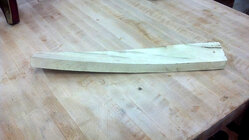
There are a lot of factors that contribute. Holly is another one where I've seen extreme warping. This small board was cut green on my bandsaw:

1769793076542.jpeg
When I actually worked for a living I did a lot of analysis on various things. I decided to analyze the way green wood warped, inspired by R. Bruce Hoadley's book "Understanding wood" and some other more technical references. (My library outgrows my shelves.)

I made 3D models of boards cut different ways from the log. Based on the tangential to radial shrinkage data in the Wood Database and elsewhere, the location and angle of the grain down the board and some cross sections of the rings down the length, and some observation/past sawmill experiences I did a quick analysis.

I think I started to figure out what was going on and could predict whether an unconstrained wet board would twist, cup, etc. as it dried. The diameter of the log matters too since a small diameter can have a greater amount of the less stable juvenile wood (board closer to the pith). It was fairly easy to visualize with the graphics but I think now that graph paper would have worked as well.

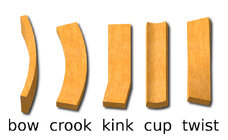
BTW, I stole this handy illustration showing the terminology of the common board warpage.
1769793871702.jpeg
Those who have sawmills know how important to sticker and weight stack of freshly sawn boards. (I use a bunch of concrete blocks) For short, thin boards I cut on the bandsaw I sometimes sticker and use clamps. As the wood dries, the stresses from shrinkage stabilizes somewhat. Heat from a kiln does this faster. (One exception is Eastern Red Cedar - If not too thick I would often lay the freshly sawn boards out in the sun on top a flatbed trailer, flipping them over several times during the day as I saw them start to cup. It was surprising how fast 4/4 boards dried and dried flat this way!

If I saw ERC 8/4 or thicker, I do sticker and work on my patience.

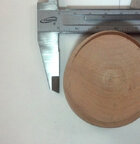
Here's an example of the T/R shrinkage in a piece of Dogwood. I had rough turned the box and lid and did the usual - put it up for a few days to let the stresses equalized. In this case the wood must not have been completely dry! In this photo of the lid the radial direction is vertical and the tangential is horizontal. The upper part is getting into the juvenile wood where all bets are off - a bad decision on my part. The gap at the caliper shows the the difference in shrinkage between the radial and tangential! I didn't leave enough wall thickness to fix it so that's one for my Box O' Shame!

1769793636762.jpeg

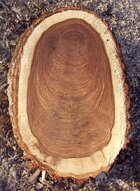
Dealing with limbs and reaction wood is interesting. This is from a cross section of a big oak limb near my barn which somehow grew almost perfectly horizontally for about 40'. Would have made a great swing limb! When it died I cut it up and counted about 100 years of rings in the limb! I suspect the best way to mill that would have been to get a nice quartersawn board or two. I do wish I'd taken the time to cut some turning blanks. :(

1769794959907.jpeg

JKJ
 
Back
Top