• December 2025 Turning Challenge: Single Tree! (click here for details)
  • Congratulations to Bob Henrickson, People's Choice in the November 2025 Turning Challenge (click here for details)
  • Congratulations to Guillaume Fontaine for "Old Tea Pot" being selected as Turning of the Week for December 15, 2025 (click here for details)
  • Welcome new registering member. Your username must be your real First and Last name (for example: John Doe). "Screen names" and "handles" are not allowed and your registration will be deleted if you don't use your real name. Also, do not use all caps nor all lower case.

Wood filler for turnings

Joined
Apr 23, 2022
Messages
15
Likes
2
Location
Lombard, IL
Hi,

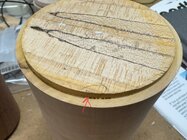
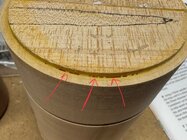
I have started turning boxes with an inset lid made from different woods. When I glue in the turned lid insert, it’s a tight fit but by the time the Titebond glue dries, its shrunk and a gap appears before I can re-turn the top. I am thinking that the water in the glue may be causing the shrinkage.

Looking for suggestions for a filler to help hide this crack which has opened up. Please see the attached pictures. I could just create a filler with glue and the resident sawdust from the outer box (Norwegian maple) but thought I would first ask the community here.

Thank you in advance.

‘Mark
 

Attachments

  • IMG_4318.jpeg
    IMG_4318.jpeg
    657.2 KB · Views: 46
  • IMG_4317.jpeg
    IMG_4317.jpeg
    899.5 KB · Views: 46
Seeing you already have some dark lines on top of the lid, you could use CA and any number of dark filling material, ie coffee grounds new or used,ebony powder or any super dark wood. I these situations I tend to make it a feature as any attempts to hide faults like this tend to look just like what it is. Wabi Sabi the Japanese call it, In traditional Japanese aesthetics, wabi-sabi (侘び寂び) centers on the acceptance of transience and imperfection
 
Appears from your images that the lid fits in tight in the areas along the lid end grain and has gaps along the sides. In my experience this would indicate that the bottom of the box has moisture and is moving slightly so it's no longer perfectly round as it dries. Maybe the lid is moving too. Hughie's idea of making it a filled feature seem like a good solution.
 
Seeing you already have some dark lines on top of the lid, you could use CA and any number of dark filling material, ie coffee grounds new or used,ebony powder or any super dark wood. I these situations I tend to make it a feature as any attempts to hide faults like this tend to look just like what it is. Wabi Sabi the Japanese call it, In traditional Japanese aesthetics, wabi-sabi (侘び寂び) centers on the acceptance of transience and imperfection
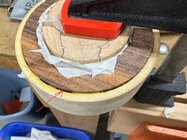
Thank you for these suggestions. Am waiting a bit longer for it to dry completely. Unfortunately the gap is not uniform around the lid. On another lid which I glued with a rosewood insert, it’s even more pronounced (see pix) and non-uniform. On that one, the gap is about 1/2 way around the insert. Perhaps as you suggest, a dark dye in the CA glue would help to hide this. Thank you again.
 
I'm new to turning but have been making solid wood furniture for 15 years. If you want to prevent this from happening in the future, be sure that the moisture content in the dissimilar woods is equal. You can see that the lid shrank exactly where you would expect it to. If you just want to fix this one, then your own idea of using glue mixed with the sanding dust will work but will still be visible. Using a dark, contrasting saw dust might not be a bad idea, giving it a ring around the collar, as it were.
 
Hi
Here’s a 2nd type of wood insert and this time it’s more pronounced. This was a piece of rosewood which I purchased, resawed and then book matched to make a larger piece. On this one, the gap goes about 1/2 way around the lid. For this one, I think the CA glue with a dark dye added may help as the insert is dark to start with.

Appreciate everyone’s comments! Thank you all.

‘Mark
 

Attachments

  • IMG_4319.jpeg
    IMG_4319.jpeg
    912.1 KB · Views: 28

Attachments

  • IMG_3192.JPG
    IMG_3192.JPG
    267 KB · Views: 18
I have started turning boxes with an inset lid made from different woods. When I glue in the turned lid insert, it’s a tight fit but by the time the Titebond glue dries, its shrunk and a gap appears before I can re-turn the top. I am thinking that the water in the glue may be causing the shrinkage.
? If it is a lid why are you gluing it in place ? What is on the other end ? What is the grain orientation of the sides of the box ?
 
Water has never caused shrinkage in wood, unless you mean loosing moisture in the wood causes shrinkage. What is the moisture content of the wood you are using? I suggest you change the design so you don’t use an insert. Gap filling is never a fix and suggests inferior work. At least in my shop.
 
Hi, thanks for your response. This insert was not wet at all, except perhaps from the Titebond glue.
Much appreciated.
I have turned a lot of boxes, always from dry wood, and periodically get reminded that they often move after they're 'finished'. Whether this is relief of stress in the wood or further drying, they get oval. Different woods are going to move different amounts.

Assuming these are end grain boxes and you're putting in an end grain insert, I'd suggest turning to almost finished diameter, let both pieces sit for 2-3 days, true them up, and then glue together.

If you're making side grain 'boxes', you might get them to work out by aligning the grain, so as the end grain elongates on the two pieces, it does so in the same direction. Personally, I don't expect face grain 'boxes'/lidded bowls to have a snug/friction fit/piston fit/suction fit lid.

I know you'd like to blame the glue, but IMHO that's not the culprit.
 
let both pieces sit for 2-3 days, true them up, and then glue together.

I always do this, as recommended by Richard Raffan and other box makers. If the wood is not completely dry, I rough turn/hollow both the lid and the box body and set them aside to dry. Raffan said to number the pieces or tape them loosely together to keep the pieces together.

But even if pieces are completely dry, there can still be stresses in the wood. I always do like Dean mentioned, turn to ALMOST the finial size then let sit for at least overnight, preferably longer. Note that all this is for end-grain boxes; side/face grain can be more trouble.

For an insert in the lid, I'd also let all pieces "rest" a few days before turning to final fit. For side/face grain boxes, I'd definitely align the grain. Even a completely dry face grain box can change/warp just moving it from one house to another and certainly can move with the seasons. A tapered-fit lid (described below) helps a lot with that but minimizing the effects of seasonal/environmental movement is one reason many turners make end grain boxes which are less likely to go out of round.

Something to consider for side/face grain fits is the orientation of the movement natural in wood as it dries and moves with the seasons. In general (as long as you stay away from the pith (and heartwood/sapwood transitions in some species), wood shrinks the most tangentially to the rings - probably the orientation across your lid and insert. (Movement along the grain is almost zero) The online Wood Database has movement data for various species. Might be best to pick species with similar shrinkage data for the best chance of them moving together instead of in opposition. (For an extreme example, I might avoid combining Mesquite and Red Oak.) This is still with final turning, fitting, and assembling after drying completely and stress relieving. The book Understanding Wood by R. Bruce Hoadley is excellent for learning all about wood movement.

@Mark Ahlenius, to fix the gaps in the pictures you showed I'd be concerned that a dark filler would look odd if the dark band was not even all the way around. If the wood is now stable, I'd be inclined to put the lid on the lathe and turn an even groove and fill that.

I hate it when the lid on any box sticks due to seasonal changes. To eliminate any misfit on both end grain and face grain boxes I now make most with tapered fit lids. Makes life easier for everyone. (The only reason I can see for making the popular suction fit boxes is to try to impress other woodturners.) People actually using the boxes usually don't want to have to use both hands or fight to remove the lid. Same with Beads-of-courage boxes. I make either internal or external tapers depending on my mood and design. Some examples:

The first box below is made from end grain. The taper-fit lid sits down a bit inside the upper rim of the box.
I made the second one with layers of face grain, all aligned - this BOC box has a internal taper on the body of the box.
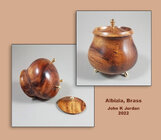
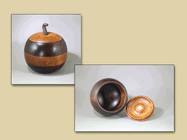
1766235862239.jpeg 1766235985934.gif

The first Beads of Courage box below has an external taper on the box, the lip on the lid is tapered inside to fit over the lower taper.
The second one has a internal taper on the box. The lids on all these boxes are easy to remove with one hand.


1766236281716.jpeg 1766239796336.jpeg

JKJ
 
Maybe not applicable in this specific scenario (filling the gap in a joint), but for small cracks I encounter while turning, I’ll lightly hand sand over the crack with 220 until the crack is full of sawdust. Then I run a bead of thin CA glue over the filled crack and immediately sand over the still-wet CA. The sawdust compresses when it’s saturated with CA, so I’ll usually do two or three rounds of this until the filled crack is flush with the rest of the piece. This is the best way I’ve found to “camouflage” small cracks.
 
I had to read the responses twice. I thought Hughie mentioned it but re reading his comment, maybe he didn't. It looks like the box is endgrain, and the insert piece is side grain. I am guessing that the piece is 3 or 4 inches wide. The end grain and side grain will move differently. Try an insert made from end grain and see if that makes a difference. Also, the wood may not have been as dry as you thought if it moved that much. I always, when making boxes, will turn them to final shape in a couple of stages to give the wood some time to "acclimate".

robo hippy
 
Maybe not applicable in this specific scenario (filling the gap in a joint), but for small cracks I encounter while turning, I’ll lightly hand sand over the crack with 220 until the crack is full of sawdust. Then I run a bead of thin CA glue over the filled crack and immediately sand over the still-wet CA. The sawdust compresses when it’s saturated with CA, so I’ll usually do two or three rounds of this until the filled crack is flush with the rest of the piece. This is the best way I’ve found to “camouflage” small cracks.

That's a good way. Another thing I learned from John Lucas for a small defects somewhere with the same wood around it is put a bit of thin CA on the sandpaper itself. Sanding the area then picks up sawdust from the area, like you do, and is pressed into the crack or chipout. Avoids the chance of staining the wood with a tiny bit of misplaced CA! (Which I've been guilty of.) In rare cases I repeat this.

If adding thin CA to a crack, I generally use one of the tiny capillary tips made for CA. Sometimes instead of fitting one on a bottle I fit it on a plastic pipette after putting a little glue in the pipette - that seems to give me more control.
Available from Amazon.
1766248100143.jpeg


I bought a lifetimes supply of pipettes here:

Apparently not currently available but these look the same:
Don't need them in large capacity.

BTW, I discovered by accident that my favorite CA, Parfix 3408, will last in good shape for several weeks in a pipette with a capillary tip. After use, I invert the pipette, blow any remaining drip out of the tip, then lay the thing down slanted so the tip is up and the CA is in the bulb.
For long life in the bottle, I replace the air with inert gas and store in the fridge.

I like this CA since it is slow to cure, will not generate heat when curing (can be used on minor cuts on people and animals), and has no nasty fumes. Works well as a finish too. I've bought it Mark Sillay carries as does the Woodturning Store also carries it.
At one time I ordered a quantity from Parsons for club members but they don't do small sales. Some turning clubs keep now it in stock.

JKJ
 
Back
Top