• The forum upgrades have been completed. These were moderate security fixes from our software vendor and it looks like everything is working well. If you see any problems please post in the Forum Technical Support forum or email us at forum_moderator (at) aawforum.org. Thank you
  • March 2026 Turning Challenge: Olla! (click here for details)
  • Congratulations to David Wyke, People's Choice in the February 2026 Turning Challenge (click here for details)
  • Congratulations to Tim Connell for "Black Locust Basket Illusion Series #4" being selected as Turning of the Week for March 16, 2026 (click here for details)
  • Welcome new registering member. Your username must be your real First and Last name (for example: John Doe). "Screen names" and "handles" are not allowed and your registration will be deleted if you don't use your real name. Also, do not use all caps nor all lower case.

Bad vapors off finishing products

Joined
Jan 24, 2010
Messages
3,302
Likes
1,012
Location
Cleveland, Tennessee
I have a number of products as WOP, Mylands Sanding Sealer, to name a few that have warnings about harmful vapors/fumes. My shop is enclosed with no outside venting. Has one window but the house has settled over the years and is jammed shut. Only way would be to go outside but at the mercy of the weather. Your thoughts?
 
Besides wearing a respirator with cartridges for volitiles, could you put an in-wall fan to the outside? A friend of mine did that - it has louvers. His is large, but I see various sizes for sale on Amazon and elsewhere.

When I worked at a large woodworking facility they had a separate finish room that exhausted fumes to the outside. I've read of some people who have small finishing tents inside the shop. Perhaps a larger one could be set up outside as needed.

I wonder if it's possible to make a finishing booth or tent for inside the shop with an exhaust fan with filters that would remove harmful fumes before returning air to the shop.

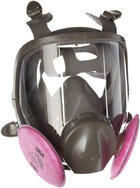
When spraying chemicals at the farm I use an industrial 3M full-face respirator with cartridge filters. Would probably work for finishes too. This one shows P100 filters for dust but they twist off and the cartridges for chemicals twist on.

1774007489482.jpeg

JKJ
 
I've got a small spray booth. It doesn't hold big things, but is enough for most of my work. It does fold up so I can just set it up when needed. It vents out a hose you can stick thru a partially open (about 2") window. I stick it out the bottom of the garage door. Not great if it's below 10ºF or whatever, but those aren't finishing days anyway for me. It would require you to fix your window, but there might be other benefits to that :) Anyway, this is the booth I have:


It does ok with vapors from wipe-on and brushed finishes, and should be ok if used as designed (for small airbrush projects). But it's a bit underpowered for how I airbrush lacquer. Still vents, just not quite enough. So I also wear a respirator with vapor (not dust) rated filters. And do my finishing at the end of the day so I can leave the shop right after.

Since you don't have a window... I have seen a YouTube video or two of someone making a water filter - basically they took a spray booth like the one above and blew the exhaust into a bucket of water. Not sure how effective that would be...
Not sure if this is one of the videos I saw, but here's one:
View: https://youtu.be/4HWM3dJ8ESc?si=Ni517JYjlGYStY2-
 
To vent outside would entail removing one pane of double glass in the window that won't open. Plus going through a block wall in the front of the house wouldn't be attractive. As for respirator, I have one but can't wear it as it throws my glasses out of focus and get lightheaded and severe headaches. Need glasses to see what I'm doing.
 
To vent outside would entail removing one pane of double glass in the window that won't open. Plus going through a block wall in the front of the house wouldn't be attractive. As for respirator, I have one but can't wear it as it throws my glasses out of focus and get lightheaded and severe headaches. Need glasses to see what I'm doing.

Sounds impractical! My friend simply knocked out the blocks on one of his outside shop walls but it is a wall that faced the woods!

Curious, what kind of respirator messes with your glasses focus? I've worn both close up and distance glasses with the 3M full-face I use and haven't noticed that with my glasses.

But would one of the 3M half mask respirators work? Should work with any glasses.

I keep multiples of these respirators around, mostly for fine dust and when working in potential toxic places like cleaning out the chicken house and sometimes mowing (I'm allergic to grass). In this case, I wear safety glasses with the respirator (or prescription glasses with side-shields and impact resistant lenses, available through our local Eye Center.

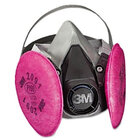
I've bought half-mask respirators from Amazon and Home Depot. The newer ones (the 7500 series) are made with a more flexible and comfortable silicon material.
www.amazon.com/dp/B008MCUT86
This pictures shows a half mask with particulate filters installed but they are interchangeable with cartridges for chemicals, organics, and volatile vapors.
1774018238082.jpeg

I tend to use the cartridges listed below but also have others (a drawer full!):
www.amazon.com/3M-Cartridge-60923-Respiratory-Protection/dp/B00AEFCKKY

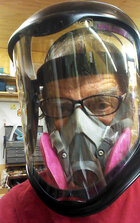
BTW, the half-mask respirators easily fit under the Uvex Bionic face shields popular with woodturners: Of course, those face shields might mess with vision through certain glasses too. :(
1774018875800.jpeg

If you have an industrial safety supplier nearby perhaps you could visit and try what they have.

JKJ
 
Well, Osmo and Rubio Monocote have no VOCs. I have been using the new "LED" finish which also has no VOCs. It does need ultra violet light to cure though. They have fancy light systems, the small one is about $650. The big one is about $1600 I think. It is intended for use on floors though. I have thus far let mine sit in the south side window and it is cured in a day. Other than that, you need to open a window and put a fan in it and do all of your finishing by the fan, or a hazardous vapors mask.

robo hippy
 
robo hippy, flytying uses an adhesive for coating thread and uses UV lights which are much cheaper. Don't have a window to open.
 
To vent outside would entail removing one pane of double glass in the window that won't open. Plus going through a block wall in the front of the house wouldn't be attractive. As for respirator, I have one but can't wear it as it throws my glasses out of focus and get lightheaded and severe headaches. Need glasses to see what I'm doing.
Would you need one of those "full" face masks? Do the fumes hurt your eyes? I do have some ventilation in my shop (i.e. I can open a door, or a garage door), but I don't during the winter. I have a half-face respirator, with the pink and mustard filters (organic fume filters, works by chemically reacting with the volatiles). To protect my eyes, I then have a small fan blowing low-speed air over the area I am working, from a bit behind and off to the side from one of my shoulders. Keeps the fumes out of my eyes, and the respirator protects my lungs and all.

The VOCs will of course stay in your shop...I don't know if you have an overhead air filter or anything like that. The filters could help absorb the chemicals from the air. You might need to replace the filters more often (the outer filters are usually washable, the inner would likely need to be replaced.)

If none of this is an option, there are now low VOC finishes and no VOC finishes that might help. Personally I am not a fan of water-based finishes, its oil or bust for me and that either means extremely long cure times..or VOCs. I've gone the VOC route, although in my case, its in my garage, and we get the long-lasting stench of gasoline exhaust, gasoline itself, and you know, all the other fumes and smells of a classic garage. And in the summer I am able to open it up and ventilate the whole thing periodically. Most of the time I'm working at night, though, and I don't generally open it up, so the VoCs do escape into the space and stay there, but I try to run my overhead air filter to suck em up. I use it at a low speed, so it doesn't just drag them strait through, and I figure between the bit of dust on the filters, and the filter material themselves, the VoCs are getting mopped up a bit.
 
The photo is like mine. I even have to play with adjusting my N-95 mask so my glasses will focus.
Is the respirator pushing the glass up a bit? Seems like that could be a problem with certain lenses. I have some the nose piece is not compatible and other that work ok.

Yikes, if that's an issue, maybe the optician could find or adjust a frame that would be better. Or the optometrist could make a change.

A long time ago I had to get a special prescription to let me use my custom large multi-monitor computer systems effectively.

I suspect you already went through the contact lens thing. My vision used to be so bad (20/400) that after years of visual suffering with glasses and terrible headaches, switching to gas permeable contact lenses instantly cured the headaches. (and were great or whitewater and scuba!) Then years later the advent of lasik surgery gave me 20/10 vision. (I'm not suggesting any of this would be appropriate for you, just wondering if there might be some other options. Last time I checked I still wasn't an eye doctor...)

Our son went through some medical things (unrelated to his eyes) in the last year that actually changed the shape of his cornia in one eye! Then another issue required special eye drops every hour of the day and night. Whew, glad that treatment is over- I get more sleep now!
 
The respirator and mask push the glasses up and out of focus. I can move the mask a bit by pinching the metal strip. Contact lenses are not on my list nor were they ever considered. No for surgery, too. My late BIL had LASIK and still had to wear glasses to read. I have a small face and have finally found glasses that fit...after 38 years.
 
BIL had LASIK and still had to wear glasses to read.

Maybe I got lucky with the LASIK. The surgeon did make a small adjustment a few weeks after the surgery to sharpen the focus in one eye.

The distance sharpness has decreased a little in the 25 years since the LASIK, but still today I can read the finest print on my phone as well to see sharp at distance for driving as long as there's enough light. When I'm driving and it starts to get dark I put on my distance glasses.

I think the wide range of focus was helped by the years of eye exercises. I'd put my thumb close, force my eyes to focus on it, then switch to something in the distance. Then repeat, often. Did this for years, continue today. My eye doctor said that likely strengthens the ciliary muscles.

I do wear very mild off-the-shelf glasses or safety glasses for turning small things. Mostly for comfort (and to keep dust out of the eyes.)

JKJ
 
Maybe I got lucky with the LASIK. The surgeon did make a small adjustment a few weeks after the surgery to sharpen the focus in one eye.

The distance sharpness has decreased a little in the 25 years since the LASIK, but still today I can read the finest print on my phone as well to see sharp at distance for driving as long as there's enough light. When I'm driving and it starts to get dark I put on my distance glasses.

I think the wide range of focus was helped by the years of eye exercises. I'd put my thumb close, force my eyes to focus on it, then switch to something in the distance. Then repeat, often. Did this for years, continue today. My eye doctor said that likely strengthens the ciliary muscles.

I do wear very mild off-the-shelf glasses or safety glasses for turning small things. Mostly for comfort (and to keep dust out of the eyes.)

JKJ

I looked into LASIK once. I asked a lot of questions, and when I asked about my ability to focus up close, I was told that it would basically destroy my ability to focus up close at all. That killed any notion of LASIK for me, as my close up vision is the most important to me. This is everything from a few inches away to a couple of feed. With my glasses I get 20/20 vision and far is fine. But I do so much detail work, including woodworking, that losing my close-up vision was an absolute deal breaker for me.

Just a word of warning for anyone who is thinking about it...if your close up vision matters to you, make sure you know what you are getting into before you commit.
 
I got rid of my high VOC products (Mylands was the worst) long ago and never looked back. Tried and True for most things, walnut oil, lots of better alternatives. The high VOC stuff will make you sick or worse eventually.
 
I looked into LASIK once. I asked a lot of questions, and when I asked about my ability to focus up close, I was told that it would basically destroy my ability to focus up close at all.

Close up focus...

I'm guessing the final focus depends on several factors, maybe age, shape of cornea, flexibility of the lens, strength of the muscles that focus the lens. As mentioned, I have good focus close and far. When I focus close, I do "something" with my eye muscles and can feel the my eyes shift in to close focus. If I just bring something, for example small text in an email on my phone, up close it is immediately WAY out of focus and unreadable at. Then I do "something" conscious in my which brings that plane mostly into focus but I still can clearly see the small text detail. Then I repeat whatever it is I do and the focus is refined.

I just did a test - I was focusing on a photo across the room and down the hall and across another small room and it was clearly in focus. Then I "switched" focus to my laptop typing this message. Then I brought my phone within 4 inches of my eyes and did the internal adjustment thing and the tiny text in my phone appointment phone calendar is now perfectly clear and readable.

I can't explain what I do in my head to switch the discrete focus and my eye doctor didn't have a good answer. All I could think of, and he agreed it was possible, that years of practice in shifting focus strengthened the muscles and taught my otherwise feeble brain to do whatever it is I do. (I feel a definite "shift" of something in my eyes.) Without glasses I can focus from 4" to the stars. A test just now showed easy focus of small text on the phone from 24" to 4" - moving the phone continuously closer I had to do a mild focus "shift" at about 12" and another stronger shift at 4".

Granted, it's a bit of an effort to hold very close focus for an extended time so I wear over-the-counter reading glasses for extended study, reading, or close work in the shop.

I think there are three aspects of clear closeup vision - 1) turning both eyes inward until they are looking at the same spot; 2) focusing the lens, and 3) narrowing the pupils. (The ancient pinhole lens effect) I'm convinced the exercises help with all three.

I don't know if this will work for everyone but the focus exercises might be worth a try. Just keep in mind I've been exercising my eyes for over 20 years now. And before LASIK I was severely nearsighted - maybe that made a difference. The focus improvement was fairly rapid (in just a few weeks after I started the exercises) but I did experience some eyestrain at first, gone now.

I have no idea what would happen if I quit the exercises for a time. I'm guessing I'd experience some regression, perhaps some eye muscle weakening.

BTW, what always amazes me is the eyesight of birds! How can a hawk see a brown baby bunny in the weeds from high in the sky? I can throw out food for chicken, peacocks, and guineas and they can always tell from 30ft away if it's something they want to eat. They don't have even bother coming close to inspect.

If anyone is interested, a recap on my eye exercises.
  1. Start by focusing on something at arms length for a but, maybe five seconds. A piece of paper with a dark mark is fine. I just hold up my thumb and focus on my thumbnail. (I guess I could hold up my middle finger but that might cause intended problems. :))
  2. Switch the focus to something in the distance and focus on that for five seconds. (You'll see two separated "ghost" thumbs due to the eye separation.)
  3. Switch focus back to the thumb and repeat 1) and 2. Do this multiple times, rest if feeling eye strain.
  4. Rest a while then repeat steps 1) through 3)
  5. After all this gets easy, move the thumb closer to the eye. Maybe 2' away instead of arm's length. Repeat steps 1) through 3)
  6. Continue to move the thumb closer, say 1', then 9" and repeat.
  7. Switch to some small text or a black pen mark on whilte paper and keep moving closer. For me, the best close range is about 4".
Do NOT do all this in one day or even one month. As mentioned, I've been excerscising like this for years, a bit almost every day, gradually moving closer. Small text on a smart phone is a perfect target for close vision since it is sharp and high contrast.

Note there may be another or better way but I never heard of it. I just made up these exercises one day about 25 years ago. But just now I asked the Supreme Google "can eye exercises improve focus" and, zounds, got basically the same instruction I just gave plus a few more Ithings might try - like the "figure 8" exercise. The first line was "Yes, specific eye exercises can improve focus by reducing digital eye strain, strengthening eye muscles, and enhancing visual coordination" So there.
.
BTW, I have cataracts too which may need surgery some day. I'm going to hold off as long as I can. My wife had the cateracts fixed some years ago and has to carry near and distance vision glasses everywhere.

JKJ

 
Besides wearing a respirator with cartridges for volitiles, could you put an in-wall fan to the outside? A friend of mine did that - it has louvers. His is large, but I see various sizes for sale on Amazon and elsewhere.

When I worked at a large woodworking facility they had a separate finish room that exhausted fumes to the outside. I've read of some people who have small finishing tents inside the shop. Perhaps a larger one could be set up outside as needed.

I wonder if it's possible to make a finishing booth or tent for inside the shop with an exhaust fan with filters that would remove harmful fumes before returning air to the shop.

When spraying chemicals at the farm I use an industrial 3M full-face respirator with cartridge filters. Would probably work for finishes too. This one shows P100 filters for dust but they twist off and the cartridges for chemicals twist on.

View attachment 86330

JKJ
Yup do the extraction fan
 
Back
Top