• The forum upgrades have been completed. These were moderate security fixes from our software vendor and it looks like everything is working well. If you see any problems please post in the Forum Technical Support forum or email us at forum_moderator (at) aawforum.org. Thank you
  • February 2026 Turning Challenge: Cookie Jar! (click here for details)
  • Congratulations to Chad Eames for "Red Tines" being selected as Turning of the Week for February 23, 2026 (click here for details)
  • AAW Symposium demonstrators announced - If the 2026 AAW International Woodturning Symposium is not on your calendar, now is the time to register. And there are discounts available if you sign up early, by Feb. 28. Early Bird pricing gives you the best rate for our 40th Anniversary Symposium in Raleigh, North Carolina, June 4–7, 2026. (There are discounts for AAW chapter members too) For more information vist the discussion thread here or the AAW registration page
  • Welcome new registering member. Your username must be your real First and Last name (for example: John Doe). "Screen names" and "handles" are not allowed and your registration will be deleted if you don't use your real name. Also, do not use all caps nor all lower case.

Bandsaw blade sharpening

Joined
Aug 14, 2007
Messages
6,701
Likes
3,871
Location
Eugene, OR
Well, I found myself down to one "new" as in unused, blade for my small bandsaw which I use for cutting the blanks into circles. I decided to sharpen it myself. I first did the old "spin it backwards with a diamond card held against the teeth with some brand new Atoma stones. I did not try to cut after that sharpening since I could never tell that it did anything worthwhile. Next, I was looking for some thing to file the gullets with. While searching for my file I use to take the raker teeth down with on my chainsaw, I came across my 3/16 inch file for sharpening the teeth on my chainsaw. Funny thing was that that file fit the gullets perfectly. I may have to try it some more. Yes, it did cut better than before I sharpened, but it didn't cut as well as a brand new blade. So, I am curious about how others sharpen their blades, and how it works for them. I do use the Lennox bimetal 1/2 inch by 3 tpi, and the thicker blades. There was a handy cut in the bandsaw table top for getting a new blade on and off so the file would line up at 90 degrees to the teeth set up.

robo hippy
 
@robo hippy, @John K Jordan shows a method at this link below, using a Dremel disc. And right below his message I posted a video from Richard Raffan where he's touching up a bandsaw blade at a bench grinder.
Post in thread 'Band Saw Horsepower' https://www.aawforum.org/community/threads/band-saw-horsepower.23239/post-282261

In the same discussion thread, post #49 from @Kirk Amidon, he describes using a Dremel chain saw stone bit to sharpen a blade.

More ideas in this thread, including video, and photos of a jig I rigged up to use a diamond hone on the teeth. Speaking of which, that blade I show could use some love again.
 
I resharpen my HSS rough out blades 3 tpi and 5 tpi with a dremel and small stones
 
After you grind the gullet its important to go back and do the reverse the blade sharpenening again. This levels all the teeth.
 
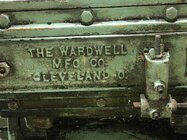
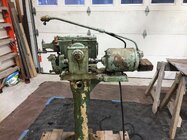
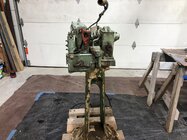
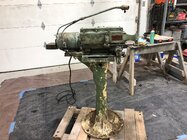
I cannot justify this purchase, except that it was reeeeally inexpensive. I doubt that it will work on the bands that we use on our saws, but we will see when I have time to play with it. This is a Wardwell band saw filer. Finding the right files to match the blade geometry will be the first challenge. Who knows, I might be getting lots of visits from club members!
 

Attachments

  • IMG_3181.jpeg
    IMG_3181.jpeg
    975.2 KB · Views: 32
  • IMG_3180.jpeg
    IMG_3180.jpeg
    835.4 KB · Views: 32
  • IMG_3179.jpeg
    IMG_3179.jpeg
    767.7 KB · Views: 33
  • IMG_3178.jpeg
    IMG_3178.jpeg
    890.2 KB · Views: 30
I tried the diamond card turning the blade backwards for a while. It helps but not a lot then I saw a video of Cindy Drozda sharpening one like John K Jordan with a Dremel and a disk. That worked better. Are they like new blades - No, but for most things I cut it's ok. If I'm going to do some re sawing I put a new blade on.
 
I sharpened the 3tpi Lenox blade 4 times before I replaced it yesterday. I think my max was 5 sharpenings. I decide when to replace by the feel of the cut.

I usually get eight blades made at a time at a local shop and hang them from a big plastic coated flat-ended hook from HD so I can reach up and grab a new one above where I stand. Eight blades will usually last me a long time. Hosing off or brushing any dirt from the log bark (or removing a strip of the bark) will make them last even longer.

JKJ
 
I cannot justify this purchase, except that it was reeeeally inexpensive. I doubt that it will work on the bands that we use on our saws, but we will see when I have time to play with it. This is a Wardwell band saw filer. Finding the right files to match the blade geometry will be the first challenge. Who knows, I might be getting lots of visits from club members!
Are yeah way to expensive, hence the manual method for me
 
Picked this up from someone's YouTube years ago and it helps to get by but again not like new. Use a round diamond bit in Dremel or like. First lift into gullet and then drag down to drop off point and repeat.
 
I’ve tried both the OP methods. Not impressed with the diamond card and backwards rotation, feel like that was just a YouTuber getting views. A chainsaw file on each tooth did improve the cut, though not nearly to new condition. But probably adequate for rough cutting blanks.
 
Diamond card with blade spinning backwards works if you blade isnt too dull. To sharpen the gullet i use a dremel with a chainsaw sharpening bit. The teeth are tilted left and right so you have to follow that with tge dremel. If you only sharpen the gullet the blade cuts really aggressively with chatter marks. Follow that up with rotating the blade backwards and the diamond file to level the teeth and you get a goid cutting blade.
 
….and about the tooth set after sharpening ?

I don't reset the teeth after sharpening. That's one reason I only sharpen more than 5 times, since each sharpening with narrow the kerf a tiny bit (usually not enough to make much difference, at least on straight cuts.

Another thing about sharpening by hand - it's not mechanical perfection. It's easy to remove a little more from some teeth and a little less from others. The biggest difference makes is subsequent cuts may not be as smooth on a straight flat cut since some teeth may cut a tiny bit wider than others. This makes zero difference when cutting turning blanks from log sections or even when prepping dry wood for turning.

JKJ
 
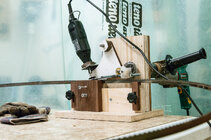
You can touch up the blade in place by a Dremel and a cut off disc. Just touch the tooth back. I made a little prototype to grinder, works quite well, in fact the prototype is still running. My prototype on Youtube

View attachment 85820
Come on!!

Ya know, what always amazes me about stuff like this is not that someone built it, it's that someone conceived the idea, dwelled upon it for two minutes or two years to get it right, and then built it. Great job!

How effective has it been for you?
 
I mostly use 1/2" 3/4 tooth kerfmaster blades from spectrum supply. I get several sharpenings from them using a dremel with a chain saw sharpening stone. I first turn the blade backwards by hand with a stone against the teeth to even everything up and then grind in a kind of sweeping motion to get the gullet of one tooth and top of the next. After several sharpenings I find that the set starts to disappear and the blade is no longer any good, even though it feels sharp. I leave the blade on the saw to sharpen. I think the kerfmaster performs as well as the wood slicer at about half the cost.
 
Come on!!

Ya know, what always amazes me about stuff like this is not that someone built it, it's that someone conceived the idea, dwelled upon it for two minutes or two years to get it right, and then built it. Great job!

How effective has it been for you?
I use the bandsaw to make things for fun, but it can also be fun to make other things like jigs and machines. It actually works quite well. If you just touch up as in the video you can sharpen a blade maybe five times.
 
I use the bandsaw to make things for fun, but it can also be fun to make other things like jigs and machines. It actually works quite well. If you just touch up as in the video you can sharpen a blade maybe five times.
Now you've got me thinking about a Dremel-based jig for use while the blade is still on the saw, revised from what I wrote about in reply #2 of this thread, shown above. Thanks for the inspiration!
 
Had a wood mizer for years, used to sharpen blades, used the wood mizer sharpener, eventually got the replacement cam for that sharpener from Timber wolf, eventually i figured out it wasnt worth the time, plus any other damage to the blades made it an exercise in futility, so just used em then tossed em, not worth sending blades back to be set and resharpened either, shipping cost plus cost of the service was more than just ordering another dozen blades, in the shop other than the blades i use for roughing blanks etc i use carbide blades, once ive used them for a while they pay for themselves so retire them like all the rest. The carbides go to the dump, the others i save because they make a pretty decent Damascus if i am motivated
 
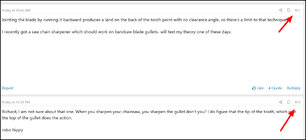
Jointing the blade by running it backward produces a land on the back of the tooth point with no clearance angle, so there's a limit to that technique.

I recently got a saw chain sharpener which should work on bandsaw blade gullets- will test my theory one of these days.
 
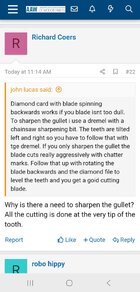
Diamond card with blade spinning backwards works if you blade isnt too dull. To sharpen the gullet i use a dremel with a chainsaw sharpening bit. The teeth are tilted left and right so you have to follow that with tge dremel. If you only sharpen the gullet the blade cuts really aggressively with chatter marks. Follow that up with rotating the blade backwards and the diamond file to level the teeth and you get a goid cutting blade.
Why is there a need to sharpen the gullet? All the cutting is done at the very tip of the tooth.
 
Richard, I am not sure about that one. When you sharpen your chainsaw, you sharpen the gullet don't you? I do figure that the tip of the tooth, which is at the top of the gullet does the action.

robo hippy
 
My bandsaw is 3-phase. I have 3-phase in the shop, but I thought I might like variable speed on the bandsaw, so I powered it with a VFD. As it turned out, I seldom slowed the speed down, but I found another benefit to the VFD. It is easy to run the blade in reverse, and I do slow it way down when sharpening. I also joint the side of the band teeth for extra smooth cuts when re-sawing.
 
I dont really sharpen the gullet per se. I start in tge gullet an pull the but down and forward. This cuts the borrom of the tooth but can shorten the tip. If you run the blade backwards with a diamond hone it levels the top and sharpens that side.
 
Richard, I am not sure about that one. When you sharpen your chainsaw, you sharpen the gullet don't you? I do figure that the tip of the tooth, which is at the top of the gullet does the action.

robo hippy

I don't see a post from a "Richard" in this thread (unless I overlooked it) so I can't find the original message. What was the comment?
 
Unless I'm supposed to feel special, it happens to everyone if there is no message #22 in the thread. ...#19, #20, #21, #23..., etc.

View attachment 85842

I think a message number can disappear if a message is deleted.

JKJ

Hmmm, well, here's what post #22 looks like right now on my phone.
1000017897.jpg
 
Back
Top