• The forum upgrades have been completed. These were moderate security fixes from our software vendor and it looks like everything is working well. If you see any problems please post in the Forum Technical Support forum or email us at forum_moderator (at) aawforum.org. Thank you
  • February 2026 Turning Challenge: Cookie Jar! (click here for details)
  • Congratulations to Matt Carvalho for "Red Mallee Folded Form" being selected as Turning of the Week for February 9, 2026 (click here for details)
  • AAW Symposium demonstrators announced - If the 2026 AAW International Woodturning Symposium is not on your calendar, now is the time to register. And there are discounts available if you sign up early, by Feb. 28. Early Bird pricing gives you the best rate for our 40th Anniversary Symposium in Raleigh, North Carolina, June 4–7, 2026. (There are discounts for AAW chapter members too) For more information vist the discussion thread here or the AAW registration page
  • Welcome new registering member. Your username must be your real First and Last name (for example: John Doe). "Screen names" and "handles" are not allowed and your registration will be deleted if you don't use your real name. Also, do not use all caps nor all lower case.

To burnish or not to burnish your burr?

Joined
Sep 30, 2021
Messages
44
Likes
11
Location
Canisteo, NY
Do you utilize the burr straight from the grinder when you’re using a NRS or should I invest in a burnishing tool? Seems like an inexpensive way to get more time at the lathe.

 
Yep, like Lou, I hate buying stuff when I can make it easily enough ..carbide rod, or even a piece of HSS bar stock (provided it is as hard or harder than your scraper steel) mounted in a flat piece of wood, with a pivot point for scraper suitably far away enough from the rod, and you have a nice scraper burnisher.
 
I was first introduced to burred scraping in 1989 at a Pro demo by Del Stubbs. Dell used an india slip stone to form the burr which worked surprisingly well but I have since developed my own method of honing the edge first then forming the bur with a hand held burnishing tool.

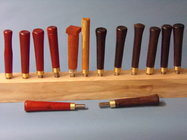
101_0440.JPG
These burnishers are made from scrap CNC router 1/2" shank bits the advantage is the shank is polished which I feel is better than the mate finish on carbide blanks. The hand held feature allows use on any configuration and with practise you can better apply the right amount of pressure to get just the right amount of burr.
 
I have several burnishing tools around the shop for both turning and flat work tools. 3/16 by 2 inch long carbide rods. I burnish the burr on my shear scrapers and my NRSs. My preferred NRS at this time is one that is ground 25 on top, and 60 on the bottom. I don't go through the process of stropping off the burr. I use the grinder burr till it is gone, then burnish down and back up. I do have one that is 45/45, and I need more practice with it. My theory is that you need a certain amount of metal under the burnished burr to support it. If I try to burnish a 30/30 skew for a burr, the edge seems to fracture. All of my shear scrapers are ground to 70 degrees, and like the NRSs, I use the grinder burr till dull, then burnish down and then back up. This process, on both tools can be done 2 to 4 times maybe before I hone off the old burr and grind a new one. With the NRS, that burr is gone in seconds. As Tom Wirsing said, "If you have to push at all, the tool is dull." I have experimented with honing a burr on my scrapers, which include my coring tools. While it does work, I get a better burr with a coarser stone. Some hone up and down, some go sideways. I think I prefer the sideways version. In all cases, the burnished burr lasts a lot longer than the grinder burr. You can burnish a burr on M2 hss with the traditional burnishing tools used for card scrapers, but I had much better luck with the triangle ones than I did with the round ones. I found it almost impossible to burnish a burr on the M42 and V10 tools with standard burnishing tools. I do not have one of the Veritas burnishing tools that you screw down to your work bench. Not positive, but I think they work best for standard scraper bevel angles, in the 60 to 70 degree range. Don't know how they would work with a NRS. With the proper burnishing tool, you do not need a lot of pressure.

robo hippy
 
Yeah, I got one of those carbide rods and mounted it in a handle. When I'm cleaning up and refining with my NRS, I'm constantly pulling that burr back up after a few passes. When that starts to yield diminishing results, I go back to the grinder.
 
I got a used carbide twist drill bit from work. Chuck it up and drill into a handle. Reverse the bit out, put in a little epoxy. Drill the bit back in. Release from the chuck and it is ready to go. There are many types of hardened drill bits that might work.
 
I burnish my burrs, much longer lasting and much more control over what you get. Lots of worn out solid carbide tools out there that can be flipped around with the sharp bits inside the handle and the butt end perfect for burnishing. You really do want a carbide burnisher for modern very hard steels like M42-- your old screwdriver won't do it.
 
Was buying something from Veritas (IIRC) on line. At check out shipping was coming to $15, but if I spent $12 more it would be free. Searching the catalog I found a hand held carbide rod burnisher for $12.50. So I essentially got paid $2.50 to "buy" mine. :)
 
Yep, like Lou, I hate buying stuff when I can make it easily enough ..carbide rod, or even a piece of HSS bar stock (provided it is as hard or harder than your scraper steel) mounted in a flat piece of wood, with a pivot point for scraper suitably far away enough from the rod, and you have a nice scraper burnisher.

Making your own stuff gives you an additional creative outlet, and sometimes you pioneer new methods as a result!

Mounting in a flat surface with a pivot point is the way to go. It gives you much more pressure to form burs. For me, this is an important aspect of creating burs on my homemade scrapers with steep grind angles...

-o-
 
Like most of us, I experimented with various forms of burnishing and settled on diamond cards. After all diamond is harder than any of the turning tool metals we use. Like Reed, I begin by using using whatever burr forms straight of the grinder and then refresh a number of times at the lathe before returning to the grinder. I have found that maintaining a high polish on the upper bevel improves the quality of the burr formed. I do that with a rag wheel charged with honing compound... it's extremely quick.

If I was using a burnishing rod I would get one of these (just the rod) or make one to match my requirements. You would need some form of diamond wheel to do that with.
 
How about a disused solid carbide 1/4" straight bit mounted in a piece of steel or aluminum? That could work too.
The burnisher that I make and use are 1/2" shank combo up cut down cut because they are available and they can only be resharpened until the transition between the up cut and down cut no longer meet so they become junk. The half inch shank works just as well as the smaller diameters and if you think about it the larger diameter will gradually form the bur compared to the smaller diameter. The polished surface on the scrap bit shank I think will work better then the raw surface on a carbide blank The scrap bits I mount with the shank out and the flutes set in epoxy.
 
BURNISHERS
I’ve written earlier about brunishers. I’ve tried a number of carbide rods of different diameters and they all work. They work better holding at the proper angle and pressure.

However, I’ve given most of them away in favor of the French-made Arno burnisher. After using it I’ll never willingly go back. It has multiple advantages over a straight rod in a handle, all described elsewhere. I like the Arno so much I bought a second one for “just in case”, as in just in case I misplace it or give it to someone in a weak moment. Then not long ago I bought a third one for “just in just in case”. It’s in the sealed plastic, unopened.

I use it to burnish burrs on conventional scrapers, NRS, and a variety of hand scrapers including cabinet scrapers for flat wood, such as a table top.

My thinking on the radius of the burnisher is it’s tied to the pressure used to make the burr - almost any burnishing rod will do but a smaller radius requires less force for the same burr. Besides the pressure, for me the “trick” to making an effective burr on a particular tool is the angle.

Some cabinet makers lightly lubricate the burnisher for a smoother turned edge. I haven’t needed to do this with woodturning tools.

In a pinch, the round shaft of a HSS tool will work.

JKJ
 
Back
Top