• The forum upgrades have been completed. These were moderate security fixes from our software vendor and it looks like everything is working well. If you see any problems please post in the Forum Technical Support forum or email us at forum_moderator (at) aawforum.org. Thank you
  • Congratulations to Bernie Hyrtzak, People's Choice in the January 2026 Turning Challenge (click here for details)
  • Congratulations to Matt Carvalho for "Red Mallee Folded Form" being selected as Turning of the Week for February 9, 2026 (click here for details)
  • AAW Symposium demonstrators announced - If the 2026 AAW International Woodturning Symposium is not on your calendar, now is the time to register. And there are discounts available if you sign up early, by Feb. 28. Early Bird pricing gives you the best rate for our 40th Anniversary Symposium in Raleigh, North Carolina, June 4–7, 2026. (There are discounts for AAW chapter members too) For more information vist the discussion thread here or the AAW registration page
  • Welcome new registering member. Your username must be your real First and Last name (for example: John Doe). "Screen names" and "handles" are not allowed and your registration will be deleted if you don't use your real name. Also, do not use all caps nor all lower case.

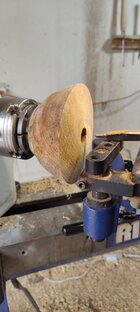
What’s on your lathe?

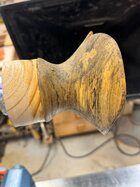
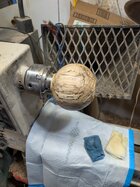
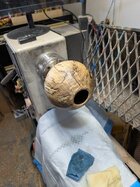
Very nice, what is your drying process?
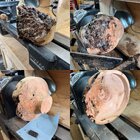
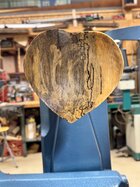
Thank you. In this case, it will be a week in a paper bag in the house and then after a week out of the bag it should be ready to sand and finish. This should be pretty quick to dry and unlikely to crack because: 1. Winter downed tree with less moisture 2. Thin turned 3. Burl is less prone to crack/split. I'll be sure to post a pick in two weeks if it turns into The Liberty Bell! 🤣
 
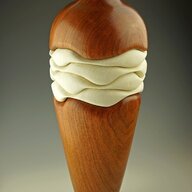
Kent just wondering what tool do you use for hollowing the inside of the top part of your form while using the Trent Bosch system. I have the same but think I need to buy an adjustable cutter of some description. Perhaps like a Jamieson cutter? Nice form Kent.
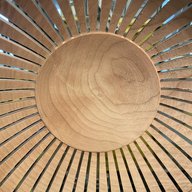
 
Kent just wondering what tool do you use for hollowing the inside of the top part of your form while using the Trent Bosch system. I have the same but think I need to buy an adjustable cutter of some description. Perhaps like a Jamieson cutter? Nice form Kent.
Thanks, Norm. I bought a cheap set of carbides that included a swan neck. I use that for the top part and general smoothing pass.
 
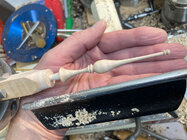
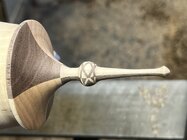
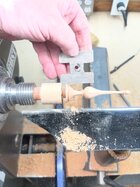
A few days ago I quickly turned a cherry rattle to show a younger turner the concept. After hollowing the head of the rattle I added a few kernels of popcorn for the rattle effect before gluing it.

I thought mung beans might be another good choice but haven’t grown bean sprouts lately, so had none in stock.

What do you all use inside this type of rattle?
Yesterday she made her first captive ring rattle. Quite good for her first time. Sent her home with two more hard maple blanks with which to practice. I didn’t think to get a photo of her turning…
 

Attachments

  • IMG_3343.jpeg
    IMG_3343.jpeg
    834.4 KB · Views: 17
  • IMG_3344.jpeg
    IMG_3344.jpeg
    650 KB · Views: 17
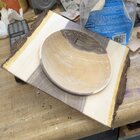
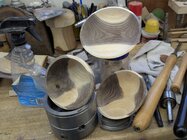
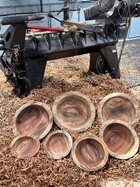
I finally got some time in my shop yesterday. Things have been busy with plowing snow, repairing our wood boiler, and helping my son buy his first home. I took some walnut from my firewood bin with the intent of just turning some simple bowls for an Empty Bowls event in May. It was wet wood, (yes, I burn wet wood) so I wasn't sanding any of them, just making shavings.

I've started to sometimes take photos during stages of more production (less artsy) type of work. The first piece somehow had a natural edge wing/rim around, so I deviated a bit to see how thin I could comfortably go and not get too bogged down. Pat Carroll did one in his demo for our club's May meeting. He also had 8 of us doing them in a hands-on class the next day.

My slight deviation to a little artsy was fun and good practice. It's nice when you have wood that you really don't care if you ruin it. It's about 3mm thick everywhere and came out OK. I was pleased that it just took 59 minutes. I did the other 3 bowls in the hour afterwards.

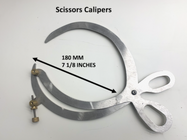
One tool that has really helped make me better (and faster) at turning bowls, is a scissor caliper that Pat left for me. I had wanted to buy one for a while, but didn't, but he gave me one for putting him up and showing him around northern Michigan a bit. (BTW, he's a great demonstrator and houseguest, so if you get the chance to have him, do it)

PXL_20260208_200509128.jpg
 

Attachments

  • PXL_20260208_211154149.MP.jpg
    PXL_20260208_211154149.MP.jpg
    516.6 KB · Views: 28
  • phoca_thumb_l_unnamed-3.png
    phoca_thumb_l_unnamed-3.png
    214.1 KB · Views: 28
Last edited:
I haven't made rattle but when I do I thought about using plastic ball bearing balls:

Or a few steel ball bearings might make a nice feel and sound.
And it seems like either a harder wood or one with good sound properties, such as Sassafras, might be nice. Have to experiment.

John, safety is paramount. Little kids are destructive little critters, and to be on the safe side it's good to assume that they will figure out a way to break a rattle. What many turners do is put dried corn kernels inside of rattles. The sound is nice, and if they happen to be ingested by the little critters then no harm is done.

 
John, safety is paramount. Little kids are destructive little critters, and to be on the safe side it's good to assume that they will figure out a way to break a rattle. What many turners do is put dried corn kernels inside of rattles. The sound is nice, and if they happen to be ingested by the little critters then no harm is done.

Good points. I did some reading about the safety specs for toys for small children and babies.

Some of the main points:
  • Choke hazards - must be large enough to not fit through a std"choke tube"
  • No small detachable parts on surface.
  • Non-toxic materials.
  • Strong enough not be broken an enthusiastic kid.
  • No sharp edges, pinch points, or splinters.
The toxic part makes me wonder if making rattles from some wood types could be a problem if chewed on. And I wonder about the components in some wood finishes. Rice? I asked Sir Google about ingesting dry rice and got this: "dry (uncooked) rice is an ingestion hazard
because it contains Bacillus cereus spores and lectins which can cause food poisoning and digestive issues like vomiting, diarrhea, and stomach pain." I didn't see where it said the type of dry rice. Pat W. said he uses popcorn kernals.

The part about splinters might be a concern with some types of wood and grain orientations.

The strength part makes me wonder about what happens if a captive ring is broken along the grain - could any pieces be choking hazards? Making the body of a hollowed rattle strong should not be a problem (unless given to the child the incredible hulk)

As for what's inside - what's inside commercial baby rattles? I've never smashed or cut one open to check.
Do they use something like rice? Sound more like plastic beads.

Hey, perhaps perfectly safe projects for captive rings would be wedding goblets and art! And things to puzzle beginning turners...

Relatively safe noise making things could be a pair of moraccas - I have several sets- kids from babies to my age love them. Google tells me they are often filled with seeds, beads, or pebbles. But not much practical use for captive rings on them...
 
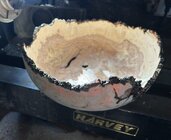
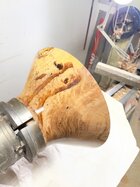
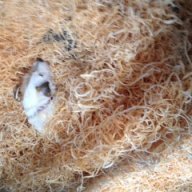
I had a fair sized piece of spalted mystery wood from the dead tree that blew down behind the garage.
Decided to turn a quick bowl but uncovered some bad rotten spots inside once I got started.
I figured it was on the lathe, so I stood to the side and kept at it till I had a rough idea on how I wanted it to look.
I set it in a plastic bowl and put a cottage cheese container inside it then filled it with blue tinted slow cure resin.
Once in the vacuum chamber the soft spots sucked up so much resin, I had to top it off twice.
It bubbled away in there for nearly an hour!
It's in the pressure pot now probably won't be cured for a couple of days.
I'll see if I can finish turning it then.

Craig

1770676674347.jpeg
 
IMG_1825.jpeg
IMG_1826.jpeg26009Urn1.jpeg
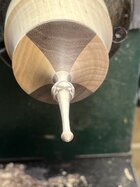
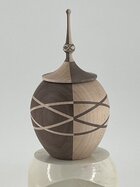
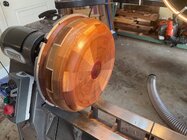
Finished the lid for a celtic cross Keepsake Urn. The cross on the body used a 22.5 degree angle and the cross on the finial lid used a 30 degree angle. The inserts for the body and the finial were cut from the blanks. The small blank was made up of 2 maple and 2 walnut 1/4" square sticks. The blanks for the body were made up of 2" square sticks. The small cross was cut with a 1 mm (.040") slitting saw mounted on my Bridgeport Mill with a wooden angle fixture holding the blank in the milling vise. The inserts for the small cross were cut with the same angle fixture and for each slice I would raise the table .080". The large inserts were cut on the miter saw to the thickness of a saw cut.
The lid has a 1.625" - 10TPI male thread and the body has the matching female thread and when I first screwed them together it was just short of alignment so I rubbed the body on a sandpaper board, tried it again and it matched perfectly. Note that when I cut the threads, if I don't already have one I make a block with the thread to use to hold the lid or body to complete it. The lid is held by a block with the female thread.
 
Last edited:
IMG_7515.jpeg

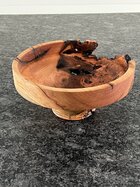
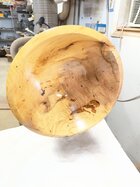
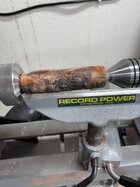
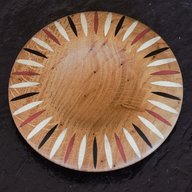
Back in my shop after 4 months of traveling. I need to turn some bowls from my shelves full of blanks so I can process some mesquite I brought back with me (to fill the shelving up again :)

Pictured is one of a half dozen various pieces turned in the last few days.
 
Back
Top