Odie does your tail stock ever get used during your bowl turning process?

-
April 2026 Turning Challenge: Salad Bowl! (click here for details) -
Congratulations to David Bartell, People's Choice in the March 2026 Turning Challenge (click here for details) -
Congratulations to Ted Pelfrey for "Cherry Blossoms on Cherry" being selected as Turning of the Week for April 27, 2026 (click here for details) -
Welcome new registering member. Your username must be your real First and Last name (for example: John Doe). "Screen names" and "handles" are not allowed and your registration will be deleted if you don't use your real name. Also, do not use all caps nor all lower case.
You are using an out of date browser. It may not display this or other websites correctly.
You should upgrade or use an alternative browser.
You should upgrade or use an alternative browser.
After 33 years with my Woodfast, a Vicmarc VL240 is now on the way!
- Thread starter Odie
- Start date

Odie
Panning for Montana gold, with Betsy, the mule!
@Odie what became of your Woodfast? Or rather, what will become if your Woodfast?
Howdy Steve......
I have taken a deposit on the Woodfast lathe and expect the buyer to be here to pick it up sometime next month.
=o=
Odie does your tail stock ever get used during your bowl turning process?
Only occasionally.
Usually only when extreme out-of-balance conditions require it.
=o=
This thread has taken on a life of its own Odie.Howdy Steve......
I have taken a deposit on the Woodfast lathe and expect the buyer to be here to pick it up sometime next month.
=o=
Only occasionally.
Usually only when extreme out-of-balance conditions require it.
=o=

Odie
Panning for Montana gold, with Betsy, the mule!
The one thing I truly hate about my VL240 lathe....is the banjo. That single position lockdown handle on the banjo got in the way too many times. To use the alternate bolt is annoying....and there is NO alternative position for the handle.
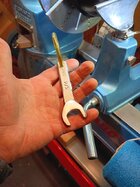
I decided to make up a wrench that stays on a hook just under the tachometer.....so I can now leave the handle replacement bolt installed permanently.
The banjo is heavily made.....I like that! ......but, Vicmarc should have thought this through a little more thoroughly. I sure do miss my old Robust Sweet 16 dogleg banjo with its reversable locking lever.
(I'd still buy this lathe....even with it's flaws....That rotating head is outstanding! Saves my back! I'm no longer wearing a back brace to do the interiors of bowls.)
=o=
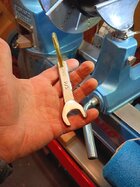
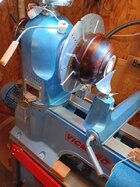
I decided to make up a wrench that stays on a hook just under the tachometer.....so I can now leave the handle replacement bolt installed permanently.
The banjo is heavily made.....I like that! ......but, Vicmarc should have thought this through a little more thoroughly. I sure do miss my old Robust Sweet 16 dogleg banjo with its reversable locking lever.
(I'd still buy this lathe....even with it's flaws....That rotating head is outstanding! Saves my back! I'm no longer wearing a back brace to do the interiors of bowls.)
=o=
Last edited:
Odie
Panning for Montana gold, with Betsy, the mule!
Another thing I'd change on the VL240, is that tachometer.
The readout is delayed by a few seconds and is useless because of it.
Vicmarc is doing the right thing by supplying the rpm readout.....but, that setup is totally useless.
Digital is fine for most applications, but an analog meter would be better, if that what is needed to have an "instant" reading.
=o=
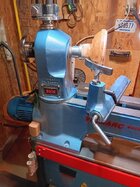
Don't know if I mentioned this before, but the red stop bar had too light a touch to stop the spindle. I found that I was accidently tripping it while working normally. If it were originally made with a stiffer spring, that would be the solution......but, I added some spongy Styrofoam behind it to stiffen it up a bit. Now, it takes a deliberate push on the stop bar to activate it...
.
The readout is delayed by a few seconds and is useless because of it.
Vicmarc is doing the right thing by supplying the rpm readout.....but, that setup is totally useless.
Digital is fine for most applications, but an analog meter would be better, if that what is needed to have an "instant" reading.
=o=
Don't know if I mentioned this before, but the red stop bar had too light a touch to stop the spindle. I found that I was accidently tripping it while working normally. If it were originally made with a stiffer spring, that would be the solution......but, I added some spongy Styrofoam behind it to stiffen it up a bit. Now, it takes a deliberate push on the stop bar to activate it...
.
Last edited:
I understand your pain with the toolrest lock handle, Odie, but I feel the need to balance the scale for the general readership.
Since 2001 until today, I've had the Papa Vicmac VL300, Mama VL200 (which remains with me), and Baby VL100 in my shop, and never once have I had issues with the toolrest locking handles on any of them (all similar to yours). I don't mean to be contrary to your likes, needs, and wishes, but I just don't want potential future users to feel that there is an inherent problem with the design that may sway them away from the machine.
To put it in perspective, the front-mounted toolrest lock handle on my Oneway 1224 (common design to their larger lathes) is well regarded by just about everyone, yet I didn't like it at all and I changed it to something else (, a ratchet-style lock handle, I have a whole thread on this that can be searched here). I don't fault Oneway, and I don't feel it is inferior or defective, it's just my personal preference.
This thread is proof positive that you demand the highest level of performance from all of your machinery, and that you'll fiddle and tweak until you've gotten something to be where you expect it to be. An admirable effort, and it shows in your work. But to balance what we watch you do to make them your own, Vicmarc is building some of the finest non-CNC woodturning machinery on the planet, and as far as I'm concerned, objectively speaking, held on the same podium as the equally high quality Oneway and Robust lathes.
But thank you for explaining the issues you have, and how you get around them. These will be meaningful to someone at some time, I'm sure.
Since 2001 until today, I've had the Papa Vicmac VL300, Mama VL200 (which remains with me), and Baby VL100 in my shop, and never once have I had issues with the toolrest locking handles on any of them (all similar to yours). I don't mean to be contrary to your likes, needs, and wishes, but I just don't want potential future users to feel that there is an inherent problem with the design that may sway them away from the machine.
To put it in perspective, the front-mounted toolrest lock handle on my Oneway 1224 (common design to their larger lathes) is well regarded by just about everyone, yet I didn't like it at all and I changed it to something else (, a ratchet-style lock handle, I have a whole thread on this that can be searched here). I don't fault Oneway, and I don't feel it is inferior or defective, it's just my personal preference.
This thread is proof positive that you demand the highest level of performance from all of your machinery, and that you'll fiddle and tweak until you've gotten something to be where you expect it to be. An admirable effort, and it shows in your work. But to balance what we watch you do to make them your own, Vicmarc is building some of the finest non-CNC woodturning machinery on the planet, and as far as I'm concerned, objectively speaking, held on the same podium as the equally high quality Oneway and Robust lathes.
But thank you for explaining the issues you have, and how you get around them. These will be meaningful to someone at some time, I'm sure.
Odie
Panning for Montana gold, with Betsy, the mule!
I understand your pain with the toolrest lock handle, Odie, but I feel the need to balance the scale for the general readership.
Since 2001 until today, I've had the Papa Vicmac VL300, Mama VL200 (which remains with me), and Baby VL100 in my shop, and never once have I had issues with the toolrest locking handles on any of them (all similar to yours). I don't mean to be contrary to your likes, needs, and wishes, but I just don't want potential future users to feel that there is an inherent problem with the design that may sway them away from the machine.
To put it in perspective, the front-mounted toolrest lock handle on my Oneway 1224 (common design to their larger lathes) is well regarded by just about everyone, yet I didn't like it at all and I changed it to something else (, a ratchet-style lock handle, I have a whole thread on this that can be searched here). I don't fault Oneway, and I don't feel it is inferior or defective, it's just my personal preference.
This thread is proof positive that you demand the highest level of performance from all of your machinery, and that you'll fiddle and tweak until you've gotten something to be where you expect it to be. An admirable effort, and it shows in your work. But to balance what we watch you do to make them your own, Vicmarc is building some of the finest non-CNC woodturning machinery on the planet, and as far as I'm concerned, objectively speaking, held on the same podium as the equally high quality Oneway and Robust lathes.
But thank you for explaining the issues you have, and how you get around them. These will be meaningful to someone at some time, I'm sure.
Thank you for your input, Steve.....
I wouldn't want to deter anyone from buying a Vicmarc lathe.....and, as I stated above, I'd still buy this lathe today. As far as I'm concerned, this VL240 is the best lathe made specifically for bowl turning nutcases like me! ha,ha!
What I'm hoping, is this thread eventually gets some attention from Vicmarc. It really would be a simple fix to slightly redesign the banjo for a better, more applicable and repositionable toolpost lockdown.
If a newer/better banjo ever becomes available......I'd buy it!
=o=
Odie
Panning for Montana gold, with Betsy, the mule!
@Odie, a couple times over the years I've had oddball questions to ask Vicmarc so I'd send an email. Prompt responses from knowledgable folk were always the norm. I bet they'd be back to you about all of your thoughts and impressions. Drop them a line. Heck, send them a link to this thread.
You know.......I thought of doing exactly that.....but, had second thoughts.
I'd like to see some improvements to the VL240, but it's my belief that if the information in this thread filters to the Vicmarc doers and shakers from other sources, they might pay more attention to it.
I will continue to give my thoughts and impressions in this thread concerning this wonderful lathe in the mean time.....
This lathe will not make me a better turner....but, it certainly will make me a happier turner....with fewer back related issues!
=o=
Odie, could you experiment with Robust and/or Oneway banjos to see if one of them would meet your needs now? Brent English at Robust is very helpful. You might want to talk to him. So happy to hear that your back problems have been reduced by your new Vicmarc 240.I'd like to see some improvements to the VL240,
Odie
Panning for Montana gold, with Betsy, the mule!
OK thanks.....
Larry sez: "Odie, could you experiment with Robust and/or Oneway banjos to see if one of them would meet your needs now? Brent English at Robust is very helpful. You might want to talk to him. So happy to hear that your back problems have been reduced by your new Vicmarc 240."
What I NEED is a long dogleg banjo. The Vicmarc banjo is perfect, except for the toolpost grub screw style of locking the tool post.....and that absurdly long locking handle.
Matter of fact, I did check out the Robust and Oneway banjos. The last time I checked, neither outfit has exactly what is needed. The long Sweet 16 banjo is long enough, but not a dogleg configuration. The short sweet 16 banjo that I have now is a dogleg style.....but, isn't long enough to use on the Vicmarc VL240 with the headstock swiveled. The Oneway banjos aren't dogleg either. If either of these manufactures wanted to produce what I need, they'd have to return to casting of the basic banjo......I don't think they'd be willing to do that.
For the time being, I believe I'll just use the Vicmarc banjo....and permanently scrap that original locking lever, in favor of the short bolt and wrench I've been using lately...
=o=
Larry sez: "Odie, could you experiment with Robust and/or Oneway banjos to see if one of them would meet your needs now? Brent English at Robust is very helpful. You might want to talk to him. So happy to hear that your back problems have been reduced by your new Vicmarc 240."
What I NEED is a long dogleg banjo. The Vicmarc banjo is perfect, except for the toolpost grub screw style of locking the tool post.....and that absurdly long locking handle.
Matter of fact, I did check out the Robust and Oneway banjos. The last time I checked, neither outfit has exactly what is needed. The long Sweet 16 banjo is long enough, but not a dogleg configuration. The short sweet 16 banjo that I have now is a dogleg style.....but, isn't long enough to use on the Vicmarc VL240 with the headstock swiveled. The Oneway banjos aren't dogleg either. If either of these manufactures wanted to produce what I need, they'd have to return to casting of the basic banjo......I don't think they'd be willing to do that.
For the time being, I believe I'll just use the Vicmarc banjo....and permanently scrap that original locking lever, in favor of the short bolt and wrench I've been using lately...
=o=
Last edited:
What I NEED is a long dogleg banjo. The Vicmarc banjo is perfect, except for the toolpost grub screw style of locking the tool post.....and that absurdly long locking handle.
Do you have a metal fab shop local to you? (cutting, machining, welding)
They can work fine with cast iron and any kind of steel. (I've never worked with cast iron myself other than drilling and tapping but long ago before I got my metal-working set up I took a broken cast iron piece to a local shop and they fixed it. (I can't remember if they welded or brazed it)
I wonder if it would be possible to modify an existing dogleg banjo to fit your machine, if it was large enough. Or add a 90-deg extension to an existing conventional banjo.
Odie - have you looked at the Robust Dogleg? I find it useful when I need to use a short (4 - 6") toolrest on my Robust AB. Might solve your problem? I actually bought it years ago when I first got my AB and had several Robust tool rests with a short post (from my previous lathe). Found it useful to get a very short tool rest into some positions.
Interesting idea Jeff...never seen one before, appreciate you posting it.Odie - have you looked at the Robust Dogleg? I find it useful when I need to use a short (4 - 6") toolrest on my Robust AB. Might solve your problem? I actually bought it years ago when I first got my AB and had several Robust tool rests with a short post (from my previous lathe). Found it useful to get a very short tool rest into some positions.
One truism I learned years ago Odie...take the most well thought out designed machine and a thousand experts will say it's perfect. Have one novice work on it for ten minutes and that person will find the one fatal mistake everyone else missed. The best laid plans and all that I guess. Personally...I love everything there is about my AB with the one lone exception of a RPM read-out. I'm learning to live without it but it still leaves me scratching my head why it isn't there?OK thanks.....
Larry sez: "Odie, could you experiment with Robust and/or Oneway banjos to see if one of them would meet your needs now? Brent English at Robust is very helpful. You might want to talk to him. So happy to hear that your back problems have been reduced by your new Vicmarc 240."
What I NEED is a long dogleg banjo. The Vicmarc banjo is perfect, except for the toolpost grub screw style of locking the tool post.....and that absurdly long locking handle.
Matter of fact, I did check out the Robust and Oneway banjos. The last time I checked, neither outfit has exactly what is needed. The long Sweet 16 banjo is long enough, but not a dogleg configuration. The short sweet 16 banjo that I have now is a dogleg style.....but, isn't long enough to use on the Vicmarc VL240 with the headstock swiveled. The Oneway banjos aren't dogleg either. If either of these manufactures wanted to produce what I need, they'd have to return to casting of the basic banjo......I don't think they'd be willing to do that.
For the time being, I believe I'll just use the Vicmarc banjo....and permanently scrap that original locking lever, in favor of the short bolt and wrench I've been using lately...
=o=
View attachment 84037
RPM meter. Nice to know? Yep. Necessity? Well...
Pics from my Vicmarc VL200-
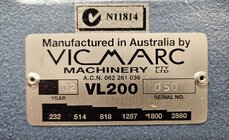
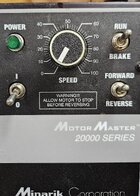
And my Oneway 1224-
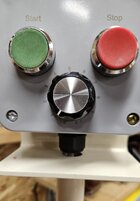
On the Vic, I keep the belt on the 1800rpm pulleys almost all of the time. If I turn the drive knob to 100, that's 1800rpm. 50- about 900rpm. Aim at 25, I should be around 450rpm. Give or take [I don't really care how many] rpms.
On the Oneway, I have two pulley choices- 0-2000rpm, and 0-4000rpm. It stays on the 2000 pulleys. And then I just adjust the knob and do a quick figuring in my head, but this time on a zero to ten scale. Setting 5 is around 1000rpm...
But honesly, I really have never cared about knowing actual RPM. And I've never used a lathe that has it. What for? (And it's just a fragile system prone to failure, anyway.) It's like driving a manual transmission car, I listen to and feel the engine and tranny as I look out the window, and along with experience, they tell me when to shift. I don't shift when a gauge tell me to. At the lathe, I listen to the running machine, feel its vibrations, and watch the spinning wood, and adjust the speed dial accordingly. I'm never going to judge what rotational speed I should introduce the cutter to the wood at because of an arbitrary number on a display, it just isn't necessary. Be liberated, skip the rpm gauge!
Nice to know? Sure. Do I need it? Nope. Do you (the greater audience) need it? Maybe, but why?
Pics from my Vicmarc VL200-
And my Oneway 1224-
On the Vic, I keep the belt on the 1800rpm pulleys almost all of the time. If I turn the drive knob to 100, that's 1800rpm. 50- about 900rpm. Aim at 25, I should be around 450rpm. Give or take [I don't really care how many] rpms.
On the Oneway, I have two pulley choices- 0-2000rpm, and 0-4000rpm. It stays on the 2000 pulleys. And then I just adjust the knob and do a quick figuring in my head, but this time on a zero to ten scale. Setting 5 is around 1000rpm...
But honesly, I really have never cared about knowing actual RPM. And I've never used a lathe that has it. What for? (And it's just a fragile system prone to failure, anyway.) It's like driving a manual transmission car, I listen to and feel the engine and tranny as I look out the window, and along with experience, they tell me when to shift. I don't shift when a gauge tell me to. At the lathe, I listen to the running machine, feel its vibrations, and watch the spinning wood, and adjust the speed dial accordingly. I'm never going to judge what rotational speed I should introduce the cutter to the wood at because of an arbitrary number on a display, it just isn't necessary. Be liberated, skip the rpm gauge!
Nice to know? Sure. Do I need it? Nope. Do you (the greater audience) need it? Maybe, but why?
Last edited:
Odie
Panning for Montana gold, with Betsy, the mule!
RPM meter. Nice to know? Yep. Necessity? Well...
Since I'm always searching for the "perfect cut"....an RPM readout is essential to my turning.
RPM is one component of the formula in searching for the perfect cut.....
=o=

Yep, Robust should at least have an option for one. Would not be that difficult to add one. Another option is to “tach the marks” either ballpark the way @Steve Tiedman does, or get a cheap optical tach from amazon - you just put reflective tape on the spindle or chuck etc, point the tach at it and get the rpm, make a cheat sheet for rpm at various marks on the speed control until you memorize them. If you want to add a digital or analog meter it would not be difficult.I love everything there is about my AB with the one lone exception of a RPM read-out. I'm learning to live without it but it still leaves me scratching my head why it isn't there?
Steve, and others who poo-poo tachs, do use a tach, though they probably won’t admit it - they relate rpm to speed dial markings - isn’t that an analog tach? That’s how my analog tachs work. I prefer to have an actual digital readout, this being the digital age and all, but a speed dial with markings works as an analog. My 1st lathe was a reeves drive, I used an optical tach to get the rpm at each of the adj handle stops, and plotted it on the dia vs surface speed chart hanging at the lathe. My current Nova does not have dial markings, so a readout on the machine is required.
Well, I don't think the speed knob itself (or gas pedal) can be considered a tachometer. Maybe the numbers around the knob in a loosely approximate sort of way, but even those aren't the meter in tachometer. But I know what you mean...Yep, Robust should at least have an option for one. Would not be that difficult to add one. Another option is to “tach the marks” either ballpark the way @Steve Tiedman does, or get a cheap optical tach from amazon - you just put reflective tape on the spindle or chuck etc, point the tach at it and get the rpm, make a cheat sheet for rpm at various marks on the speed control until you memorize them. If you want to add a digital or analog meter it would not be difficult.
Steve, and others who poo-poo tachs, do use a tach, though they probably won’t admit it - they relate rpm to speed dial markings - isn’t that an analog tach? That’s how my analog tachs work. I prefer to have an actual digital readout, this being the digital age and all, but a speed dial with markings works as an analog. My 1st lathe was a reeves drive, I used an optical tach to get the rpm at each of the adj handle stops, and plotted it on the dia vs surface speed chart hanging at the lathe. My current Nova does not have dial markings, so a readout on the machine is required.
Oh, I get it now, Odie. It's the perfect that you are forever in search of. I understand. Well, I won't interfere with that quest. Enjoy the journey along the way! May it be free of knots and splits and wood borers.Since I'm always searching for the "perfect cut"....an RPM readout is essential to my turning.
RPM is one component of the formula in searching for the perfect cut.....
=o=

Robust does have digital readout on their Scout and Sweet 16 lathes. On the AB it is an analog readout with the speed marked on the dial. I do have one of the rpm gauges and was surprised how it compared very well to the markings. I had digital readout on my Laguna 18-36 (when it worked) and guess I used it, but really don’t miss it on the AB as long as I can set the speed accurately. I do understand the need for the perfect cut at a speed, but I don’t think a digital readout really gets me there. It is more of a feel. You set the speed and then tweak the rpm to find it.
Fourteen years ago I brought my (then) new AB into the shop, having upgraded from the Jet 1642 I'd been using for several years. Within a couple of weeks I was figuring out how to add a digital RPM readout to it. It wasn't very difficult, and Amazon meant that the parts arrived quickly - another week and I had it rigged, in a small box with rare earth magnets that fit easily above the pendant on the headstock. I had it all.
What I found was that its only real use was to give me a rpm number that I could use to identify what actual speed each number on the speed dial was giving me. Within a month or two it was so seldom used that I took it all off - haven't missed it in the nearly decade and a half since.
As has been mentioned, a small optical tach can be found for a few bucks on amazon or ebay. take a few minutes to chart the rpm at each point on the speed dial and you're done.
What I found was that its only real use was to give me a rpm number that I could use to identify what actual speed each number on the speed dial was giving me. Within a month or two it was so seldom used that I took it all off - haven't missed it in the nearly decade and a half since.
As has been mentioned, a small optical tach can be found for a few bucks on amazon or ebay. take a few minutes to chart the rpm at each point on the speed dial and you're done.
....an RPM readout is essential to my turning.
When I want to measure RPM on some device that doesn't have a sensor/readout I use an inexpensive optical tachometer. It came with reflective tape to put on a shaft.
www.amazon.com/dp/B004Q8L894
I have an uncalibrated speed dial on my milling machine so I used it to read the speed at different dial positions and wrote them on the dial. Could just make a diagram and keep it handy.
Don't use it much but it's handy on occasion.
My lathe (and previous lathes) have had the RPM displays. However, I rarely look at them unless someone asks what speed I'm turning. I guess I got used to the feel of the tools vs the sounds cues.
Could prob rig up one like described above to read and display the RPM either all the time or on demand, mounted with a bracket or maybe disassemble and separate the optical and readout components. I haven't checked, there may be other options available, maybe one with a magnetic sensor that could be mounted somewhere inside the headstock (like in other lathes). I put a different type on a gasoline engine but it monitored the spark plug; wouldn't work here.
JKJ
Agreed!I do understand the need for the perfect cut at a speed, but I don’t think a digital readout really gets me there. It is more of a feel. You set the speed and then tweak the rpm to find it.
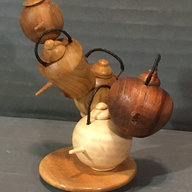
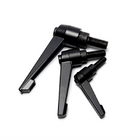
Odie, if that stubby little remnant of a crescent wrench is all the length you need on the lock bolt, A) couldn't you weld a rod on the end of the bolt at your preferred angle, when it's tight?, or B) couldn't you find one of the adjustable/positionable locking bolts in the proper screw thread and handle length, as below?
Odie
Panning for Montana gold, with Betsy, the mule!
Odie, if that stubby little remnant of a crescent wrench is all the length you need on the lock bolt, A) couldn't you weld a rod on the end of the bolt at your preferred angle, when it's tight?, or B) couldn't you find one of the adjustable/positionable locking bolts in the proper screw thread and handle length, as below?
View attachment 84073
Howdy Dean......it's been a mild winter for us, but it ain't over yet!T
Thanks for your idea A)......I may eventually do that.
As for B) ..... There really isn't any commercially available adjustable handles that would work in that location. What I need is an alternate position to lock down the toolrest.
You guys have been very helpful with your suggestions.......makin' me think!
=o=
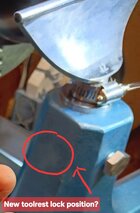
@Odie, below is a blow up crop of your recent banjo photo. I think there is enough meat in the banjo casting above the banjo cam lock handle to have a machine shop (or you, if you're up to it) drill and tap a hole to move the tool rest lock to that new position. You may need to shorten the handle at the new position to clear the banjo profile above the cam lock. The steel adjustable handle I bought for my Oneway (not the zinc or plastic version) that I link in my message thread covering my story is beefy enough to be shortened a bit to work at that position. This position is where all Oneway banjos have the tool rest lock. I'd keep a bolt in the factory hole to keep debris out. Does this solve the issue for you?
What a simple and practical solution for quickly setting the tool rest at the correct height.
I always learn something here every time I read a thread.
Bob
Yeah maybe not a tach, but a “cruise control”, once one knows the dial markings to rpm, and the drive system does control speed under varying load, it all operates just like one. The point is, folks with markings on the dial know what rpm they are at, not flying “blind” with nothing to relate to speed but “feel” (yes adj speed a bit to”smooth things out” applies to both). The whole debate over rpm readout or dial markings is nonsensical - both parties know where they are starting, and then fine tune.Well, I don't think the speed knob itself (or gas pedal) can be considered a tachometer. Maybe the numbers around the knob in a loosely approximate sort of way, but even those aren't the meter in tachometer. But I know what you mean...
Odie
Panning for Montana gold, with Betsy, the mule!
What a simple and practical solution for quickly setting the tool rest at the correct height.
I always learn something here every time I read a thread.
Bob
Hello Bob.....
I think you're referring to the hose clamps I have on all my tool rests. This allows me to quickly come to the right tool rest height by queuing the hose clamp to markings I have on the tool rest shaft.
As a residual benefit.....using the hose clamps means much less pressure is needed to secure the rest because the hose clamp secures the tool rest vertically. The banjo's method of securing the tool rest ONLY needs to secure it radially......and NOT vertically.
=o=
Odie
Panning for Montana gold, with Betsy, the mule!
@Odie, below is a blow up crop of your recent banjo photo. I think there is enough meat in the banjo casting above the banjo cam lock handle to have a machine shop (or you, if you're up to it) drill and tap a hole to move the tool rest lock to that new position. You may need to shorten the handle at the new position to clear the banjo profile above the cam lock. The steel adjustable handle I bought for my Oneway (not the zinc or plastic version) that I link in my message thread covering my story is beefy enough to be shortened a bit to work at that position. This position is where all Oneway banjos have the tool rest lock. I'd keep a bolt in the factory hole to keep debris out. Does this solve the issue for you?
View attachment 84074
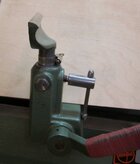
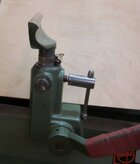
Thanks Steve......yes, that would make my banjo much more usable for my needs. I've been thinking about doing this myself, but have been procrastinating. The hole would need to be drilled perfectly to match the opening in the 1" sleeve.
This is what Vicmarc should have done, and Woodfast did do with their similarly made banjos. (see photo)
=o=
Hello Bob.....
I think you're referring to the hose clamps I have on all my tool rests. This allows me to quickly come to the right tool rest height by queuing the hose clamp to markings I have on the tool rest shaft.
As a residual benefit.....using the hose clamps means much less pressure is needed to secure the rest because the hose clamp secures the tool rest vertically. The banjo's method of securing the tool rest ONLY needs to secure it radially......and NOT vertically.
=o=
View attachment 84078
Yes, exactly.

Odie, with regard to your tool post clamping issue, until the latest helpful hints you've received regarding drilling and tapping a new hole; I never fully understood your issue with the OEM banjo; now I do.
I agree fully with you in this regard as the Vicmarc banjo is very well made, and with a tool post diameter of 30mm, rigid as anything and about the best I've ever used. But the placement of the locking lever does leave room for improvement.
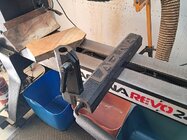
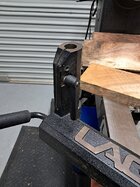
Until I purchased my Revo 2436 lathe, I always considered the Vicmarc banjo the best I had ever used for rigidity. The Laguna Revo 2436 banjo is a brilliantly thought out design and is rock steady and locks down easier than any other banjo I've ever used. It is also the only other banjo that is as rigid as the Vicmarc units, that I have used that is.
The design feature I like the most is that it clamps the tool post along its length, assuring an unbelievable rock steady grip. A bonus for you is that it is designed for 25.4mm tool posts, the possible downside for you, is that it will not hold a 25mm tool post.
One of it's best features, is that you can position the locking bolt clamp on the front, or on the rear.
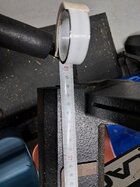
The height above the bed ways is 55mm to the top of the lettering, the length is 480mm.
Some food for thought.
I agree fully with you in this regard as the Vicmarc banjo is very well made, and with a tool post diameter of 30mm, rigid as anything and about the best I've ever used. But the placement of the locking lever does leave room for improvement.
Until I purchased my Revo 2436 lathe, I always considered the Vicmarc banjo the best I had ever used for rigidity. The Laguna Revo 2436 banjo is a brilliantly thought out design and is rock steady and locks down easier than any other banjo I've ever used. It is also the only other banjo that is as rigid as the Vicmarc units, that I have used that is.
The design feature I like the most is that it clamps the tool post along its length, assuring an unbelievable rock steady grip. A bonus for you is that it is designed for 25.4mm tool posts, the possible downside for you, is that it will not hold a 25mm tool post.
One of it's best features, is that you can position the locking bolt clamp on the front, or on the rear.
The height above the bed ways is 55mm to the top of the lettering, the length is 480mm.
Some food for thought.
Odie
Panning for Montana gold, with Betsy, the mule!
Odie, with regard to your tool post clamping issue, until the latest helpful hints you've received regarding drilling and tapping a new hole; I never fully understood your issue with the OEM banjo; now I do.
I agree fully with you in this regard as the Vicmarc banjo is very well made, and with a tool post diameter of 30mm, rigid as anything and about the best I've ever used. But the placement of the locking lever does leave room for improvement.
Until I purchased my Revo 2436 lathe, I always considered the Vicmarc banjo the best I had ever used for rigidity. The Laguna Revo 2436 banjo is a brilliantly thought out design and is rock steady and locks down easier than any other banjo I've ever used. It is also the only other banjo that is as rigid as the Vicmarc units, that I have used that is.
The design feature I like the most is that it clamps the tool post along its length, assuring an unbelievable rock steady grip. A bonus for you is that it is designed for 25.4mm tool posts, the possible downside for you, is that it will not hold a 25mm tool post.
One of it's best features, is that you can position the locking bolt clamp on the front, or on the rear.
The height above the bed ways is 55mm to the top of the lettering, the length is 480mm.
Some food for thought.
View attachment 84127View attachment 84129View attachment 84130
Thanks for your input, Mick....
If I knew of a banjo that was made for a 16"-20" swing, dogleg configuration, 1" post hole, a more appropriate locking mechanism for the tool rest, and extra long.......I'd probably bite the bullet and buy it!
I am in love with this VL240 lathe otherwise!
=o=
@Odie I had the Laguna 18-36. I never had a problem with the banjo clamping. It basically squeezed the casting to clamp the tool rest. Some however did not like this banjo. Just curious if OneWay design make a banjo for the VL240. I’m sure pricy, but they are highly acclaimed. Likely would need to consider the gap between the ways. Also since you had the Robust and liked it was wondering if Robust made one similar for the VL240. Maybe discussed somewhere in this 8 page thread already, but I might have missed it. One last thing I love my Robust AB more than you love your Vicmarc.
Odie
Panning for Montana gold, with Betsy, the mule!
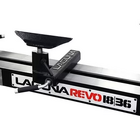
@Odie , Laguna makes an 18" swing (1836) lathe. The banjo looks like it may have the features you mention. Maybe not, but worth a glance anyway. The Woodcraft site has a lot of pictures.
Thanks for the suggestion, Mark. To me, that banjo looks a little short for my use.
The mating surfaces of the banjo to the bedways need to be around 19 1/2"
This is why I can't use my Sweet 16 dogleg banjo......wish I could, but it's just not long enough.
=o=
Last edited:
Odie
Panning for Montana gold, with Betsy, the mule!
That 1836 banjo toolrest clamp would be of concern for me, too.......@Odie I had the Laguna 18-36. I never had a problem with the banjo clamping. It basically squeezed the casting to clamp the tool rest. Some however did not like this banjo. Just curious if OneWay design make a banjo for the VL240. I’m sure pricy, but they are highly acclaimed. Likely would need to consider the gap between the ways. Also since you had the Robust and liked it was wondering if Robust made one similar for the VL240. Maybe discussed somewhere in this 8 page thread already, but I might have missed it. One last thing I love my Robust AB more than you love your Vicmarc.
Last I checked, none of the Oneway banjos are dogleg style..... The VL240 is a dogleg style, and if it wasn't, I'd probably still be turning on my old Woodfast lathe!
Oh, I know how much you guys love your Robust lathes. I consider them to be top tier lathes.
Matter of fact, I was in communication with Brent prior to my purchase of the VL 240. I offered to pay in advance, if he would design and build me a rotating headstock Sweet 16 lathe.....he wasn't interested in that.
I hadn't thought of asking Brent if he'd make a banjo specifically for the VL240.....but, I suspect he wouldn't be interested in that either. If he did, he might lose some lathe sales.....because in my opinion, the VL240 is a more attractive lathe for us bowl turners, specifically because of the rotating headstock.
@Brent@TurnRobust
=o=
Last edited:
THANKS for the suggestion...When I want to measure RPM on some device that doesn't have a sensor/readout I use an inexpensive optical tachometer. It came with reflective tape to put on a shaft.
www.amazon.com/dp/B004Q8L894
I have an uncalibrated speed dial on my milling machine so I used it to read the speed at different dial positions and wrote them on the dial. Could just make a diagram and keep it handy.
Don't use it much but it's handy on occasion.
My lathe (and previous lathes) have had the RPM displays. However, I rarely look at them unless someone asks what speed I'm turning. I guess I got used to the feel of the tools vs the sounds cues.
Could prob rig up one like described above to read and display the RPM either all the time or on demand, mounted with a bracket or maybe disassemble and separate the optical and readout components. I haven't checked, there may be other options available, maybe one with a magnetic sensor that could be mounted somewhere inside the headstock (like in other lathes). I put a different type on a gasoline engine but it monitored the spark plug; wouldn't work here.
JKJ
Hi Odie, with a 19 1/4" swing the VL240 is right between our banjos for our 16" Sweet 16 and the 25" American Beauty. We can cut down the American Beauty banjo to fit the VL240, and we do that for the PM 3520 (20" swing). We sell a lot of 16" banjos for the Laguna 1524 and 1836. As mentioned by others above, their clamping mechanism relies on pinching the cast iron, and it's very fussy about the exact size of the toolrest post. Our clamping mechanism tolerates a lot more variability. Here's a word-for-word quote from a recent customer:I hadn't thought of asking Brent if he'd make a banjo specifically for the VL240.....but, I suspect he wouldn't be interested in that either. If he did, he might lose some lathe sales.....because in my opinion, the VL240 is a more attractive lathe for us bowl turners, specifically because of the rotating headstock.
My S16 Spindle Banjo came today for my Revo 15/24 lathe. I installed it and it went together and mounted very easily. I am very pleased with how easily it tightens to the lathe bed ways and how it clamps the tool rest posts. It easily clamps both my 25.4 [1"] and 25mm tool rest posts securely with very little effort. I also had some 5/8” post tool rests from an old lathe I used to have and with an adapter (split sleeve to take it to 1 inch) those old rests also clamp down. That was totally unexpected.
For the record, I try not to promote my products on this forum, but I thought this reply was warranted to provide clarification. And yes Odie, I agree that the VL240 is a fine lathe. I think woodturners are operating in a "golden age" of turning tool and lathe options. Lots of great things on the market from a great assortment of suppliers.
And Odie, please don't be upset about me not making you a custom S16 with a swiveling headstock. It had nothing to do with you, and everything to do with me setting priorities here at the shop. Thanks for the opportunity to comment.