• The forum upgrades have been completed. These were moderate security fixes from our software vendor and it looks like everything is working well. If you see any problems please post in the Forum Technical Support forum or email us at forum_moderator (at) aawforum.org. Thank you
  • Congratulations to David Bartell, People's Choice in the March 2026 Turning Challenge (click here for details)
  • Congratulations to Steve Gray for "White Oak Handled Bowl" being selected as Turning of the Week for April 6, 2026 (click here for details)
  • Welcome new registering member. Your username must be your real First and Last name (for example: John Doe). "Screen names" and "handles" are not allowed and your registration will be deleted if you don't use your real name. Also, do not use all caps nor all lower case.

What’s on your lathe?

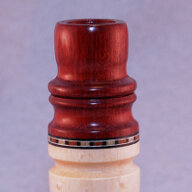
Ah, finial finesse is a first-class function!
I don't remember seeing the Lucas method demonstrated but then my brain cell count is constantly decreasing. I think he told me once he turned a longer taper than I do. Probably holds better, but not needed for how I use one.

Hey, I did a demo on my 2MT holding in the Crossville club in June of 2016. I didn't see you there. WHAT, you missed that one??? :)

And showed/taught it in nine other clubs, private sessions, and workshops. Missed those too??? I have another one scheduled for a club in Charlotte NC in a couple of months. I always show that holding method when I demo thin spindles since it has several advantages. The way I make and used them is also in my Thin Spindle doc posted on this site too (Appendix 1, page 20).

JKJ
The wooden block in the pic is to size the two ends of the taper and the length is 2”.
 
Speaking of putting things on your lathe,,,
What is the best orientation for crotches? I mean, i know laying it flat on my mill gets me the best figure but whats the best when poking it on the lathe?
 
Speaking of putting things on your lathe,,,
What is the best orientation for crotches? I mean, i know laying it flat on my mill gets me the best figure but whats the best when poking it on the lathe?
"Best" depends on what you are making, how you want to capture the figure, and a lot on the individual log. Lots of compromises.
The best figure in a crotch is usually right between the branches.
So if you want to capture that figure in what you're making, try to avoid turning it into shavings.
That starts at the chainsaw/bandsaw but obviously also on the lathe.

If you're making a bowl, you might want to get the crotch figure in the bottom of the bowl, because at the rim it usually doesn't show well (and most of it ends up on the floor). But having the crotch at the bottom means the rim is around the outer edge of the wood (the bark) and that may limit the size of the bowl. A natural-edge bowl is often a good choice as the figure is in the bottom and the branches sorta give the bowl a heart shape. You might also need to include some of the pith(s) to capture more figure (bandsaw/chainsaw cut offset from center), which (besides dealing with pith in your bowl) means you get one figured piece rather than two.

Similar sort of tradeoffs apply if you're making a platter, but it's probably easier to capture more figure across more of a shallow platter.

If you're doing a hollow form, you can orient the form side-grain so the figure is around the outside of the vessel (but so are the piths possibly). If the log is large enough, you might go side-grain with the top of the vessel in the figure (and maybe avoid the piths). Or you can orient the form so that the mouth of the vessel is pointing between the branches, which will probably get more figure across the top of the vessel. But you still may have pith to deal with (depending on relative size of the vessel and crotch).
 
"Best" depends on what you are making, how you want to capture the figure, and a lot on the individual log. Lots of compromises.
The best figure in a crotch is usually right between the branches.
So if you want to capture that figure in what you're making, try to avoid turning it into shavings.
That starts at the chainsaw/bandsaw but obviously also on the lathe.

If you're making a bowl, you might want to get the crotch figure in the bottom of the bowl, because at the rim it usually doesn't show well (and most of it ends up on the floor). But having the crotch at the bottom means the rim is around the outer edge of the wood (the bark) and that may limit the size of the bowl. A natural-edge bowl is often a good choice as the figure is in the bottom and the branches sorta give the bowl a heart shape. You might also need to include some of the pith(s) to capture more figure (bandsaw/chainsaw cut offset from center), which (besides dealing with pith in your bowl) means you get one figured piece rather than two.

Similar sort of tradeoffs apply if you're making a platter, but it's probably easier to capture more figure across more of a shallow platter.

If you're doing a hollow form, you can orient the form side-grain so the figure is around the outside of the vessel (but so are the piths possibly). If the log is large enough, you might go side-grain with the top of the vessel in the figure (and maybe avoid the piths). Or you can orient the form so that the mouth of the vessel is pointing between the branches, which will probably get more figure across the top of the vessel. But you still may have pith to deal with (depending on relative size of the vessel and crotch).
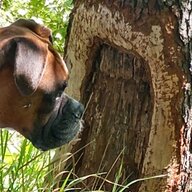
Its been a conundrum, stand there looking at the damn things for hours thinking through the variations, i have a pretty sizable pile of logs that i stuck on the side recently from doing some clearing on my place just to turn into blanks, huge number of crotches of all different sizes, am contemplating my next move with them as i want to maximize the yield, nice material can be hard to come by. Is mostly koa but also have a bunch of jacaranda and Monterey cypress in there, at the moment all in logs end coated to minimize checking, but know full well i need to do something with it all soon. They range from stuff in the 30” range to 8”, Some of the big ones i want to saw down on my mill and turn platters, think those would be nice.
Want to give my coring setup a workout too rather than just having a huge pile of very valuable shavings.
If thats not confusing enough i have a couple pretty big root balls, those have me stumped! Pun intended. But seriously they are all over the place grain wise.
🧐
 
Famous last words.......

"I'll just clean this up inside just a little bit more and let it dry"

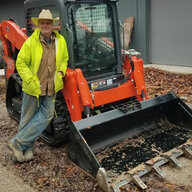
I think it might have caught in that big worm trail. Too slow of rpm maybe. What's a good average rpm for inside hollow forms roughly 5-6 inch diameter?
 

Attachments

  • PXL_20260218_210835798.MP.jpg
    PXL_20260218_210835798.MP.jpg
    481.6 KB · Views: 34
Famous last words.......

"I'll just clean this up inside just a little bit more and let it dry"

I think it might have caught in that big worm trail. Too slow of rpm maybe. What's a good average rpm for inside hollow forms roughly 5-6 inch diameter?
Sam, I’m usually around 800 to 1000 rpm. I’m sure everyone has a preference.
 
Too slow of rpm maybe. What's a good average rpm for inside hollow forms roughly 5-6 inch diameter?

I think the speed depends on things like the wood type, quality, strengh/weakness, defects, balance, mounting method, tools used, skill of turner. My favorite wood for hollowing is eastern red cedar - fine grain, smooths like glass.

For turning in general, a commonly quoted "rule of thumb" is to divide 6000 by the diameter of the piece. Then divide 9000 by the diameter. Somewhere between those two numbers is a possibly useful lathe speed. I haven't seen a similar formula for hollowing.

That said, with good wood, well secured to the lathe and turned round for balance I tend to crank the speed up. A higher speed can cut more smoothly with the caveats given even with the narrow scraper bits usually used in hollowing tools. At a slow speed the tool bit can catch on defects (if you let it) rather then skip over them and catch the high spots. I prefer to use one of the Hunter tools for hollowing which, I think, makes things easier.

On the inside an issue is chips that can build up - stop and clear constantly. Chips cleared, back to higher speed.

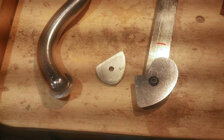
However, if the opening is large enough to see or feel inside, after hollowing I slow WAY down to a crawl and smooth the wood with curved scrapers. Here are some. The round and teardrop are Sorby. I made the one on the right and some others, often use them on Sorby handles. (all must be sharpened properly.) Then sand to a fine grit. If a finger can fit inside the piece, the wood will be as smooth as a baby's cheek or no one will ever touch it.

1771467681304.jpeg

But I've always hollowed dry wood, never green. I've watched the late great John Jordan hollow green and seems like he was turning at a good clip, inside and out. Clearing chips often.

If new to hollowing, an experienced mentor can be huge help. Many clubs have lists of people willing to help.
 
Sam, I’m usually around 800 to 1000 rpm. I’m sure everyone has a preference.
I was pretty slow around 550. I don't know if that contributed or not. Kept hitting a spot where it was grabbing, figured it was that hole that's visible.
 
I was pretty slow around 550. I don't know if that contributed or not. Kept hitting a spot where it was grabbing, figured it was that hole that's visible.

I think that could be a possibility. As mentioned, if the speed is higher (and not mentioned) if you have a firm grip with the tool at the right presentation so the tip is simply "cutting air" when passing the defect, the cut shouldn't dip into the defect. I and others have many times turned pieces with voids and inside and out this way. I prefer good, solid wood, but some equally love good holes and voids!

This is also the way to turn pieces like platters with wings and corners. When I do those, the I keep the speed pretty high. (Not as fast as Jimmy Clewes, though! Some of his sound like a prop plane taking off and some in the audience get up and move away from the "line of fire". :))

For example, If I don't turn these at higher speed (with an absolute grip on the tool, cut depth controlled by the forefinger sliding along the tool rest), I could have problems at the corners, both inside and out.
1771517477031.jpeg 1771517507178.jpeg
I've never looked that the speed but I'm guessing it's pushing 1500 rpm. (Wood is solid, no cracks or defects, held securely in the first photo with a screw chuck.)

JKJ
 
Last edited:
Catching up and turned some handles for some unhandled tools today. 3/4” Robust skew, 1” Robust round nose bowl scraper, 1” Sorby round nose scraper and a chuck lever. I also repurposed an ottoman chair leg into a lidded box yesterday.
 

Attachments

  • IMG_2890.png
    IMG_2890.png
    4.8 MB · Views: 26
  • IMG_2894.jpeg
    IMG_2894.jpeg
    968.5 KB · Views: 26
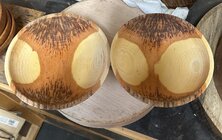
A friend brought me two sections of walnut that had been laying out in the weather for a couple years. Most had splits in the sap wood but I found a crotch piece that look fairly good. I’ve had it covered and off the ground for a few months. I was able to turn a 12-1/4” and 13-1/2” today. Sanded to 180 and will put on the drying rack for a couple months and finish sand when dry.

1771715161727.jpeg

1771715102559.jpeg


1771715064610.jpeg
 
A friend brought me two sections of walnut that had been laying out in the weather for a couple years. Most had splits in the sap wood but I found a crotch piece that look fairly good. I’ve had it covered and off the ground for a few months. I was able to turn a 12-1/4” and 13-1/2” today. Sanded to 180 and will put on the drying rack for a couple months and finish sand when dry.

View attachment 85448

View attachment 85447


View attachment 85446
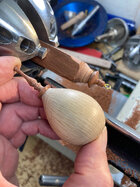
Wow! I love the figure in those pieces.

Bob
 
"Nothing" HAHA, and that is a good thing!

It means I finished my Game call. So simple, yet takes me forever!
and finished a green-ish wood Bud Vase, it is going to the Sweet Ex this Tuesday.
 
Completed four ornaments tonight. This was the smallest of the bunch. This hollowed globe of Post Oak had already been completed but I turned the finials of Ipe tonight. The top finial has the eyelet glued in and the longer bottom finial is in the "clamp" waiting for 5 minute epoxy to do its thing. After this, all four ornaments were finished with a thin natural looking rubbed-in finish.
1771745191461.jpeg
 
A friend brought me two sections of walnut that had been laying out in the weather for a couple years. Most had splits in the sap wood but I found a crotch piece that look fairly good. I’ve had it covered and off the ground for a few months. I was able to turn a 12-1/4” and 13-1/2” today. Sanded to 180 and will put on the drying rack for a couple months and finish sand when dry.

View attachment 85448

View attachment 85447


View attachment 85446

Those are beautiful! They’ll really pop when you put a finish on there!
 
A friend brought me two sections of walnut that had been laying out in the weather for a couple years. Most had splits in the sap wood but I found a crotch piece that look fairly good. I’ve had it covered and off the ground for a few months. I was able to turn a 12-1/4” and 13-1/2” today. Sanded to 180 and will put on the drying rack for a couple months and finish sand when dry.

View attachment 85448

View attachment 85447


View attachment 85446
What was the orientation of the crotch when you cut it? Almost looks like it was sort of angling across it as it looks like the heart centers in there but kinda on an angle? Just asking because i have a pile of crotches and trying to figure out how to blank them
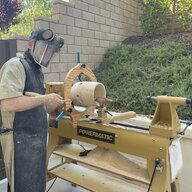
 
What was the orientation of the crotch when you cut it? Almost looks like it was sort of angling across it as it looks like the heart centers in there but kinda on an angle? Just asking because i have a pile of crotches and trying to figure out how to blank them
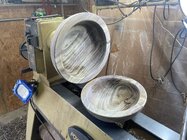
The limbs forked off the top of the crotch and I split the crotch right through the middle of the pith. I had to cut back the length before splitting due to cracks on both ends.
This section of the piece was wider than it was thick so more or less an oval log section.
The top two pictures had more feathering type grain structure on that side but the bottom picture had another limb coming off that side, so when flipped and turning the inside of the bowl I was turning end grain until I got past the limb.
 
Last edited:
Mystery wood

7 x 6 ??

I'm guessing who ever supplies the wood for the railroad tie plant rips them off occasionally because it might be poplar and I wouldn't think they would make a railroad tie out of that.

I turned it to 1/4 inch and it checks as quick as I can put CA glue in them. I'll be surprised if it survives the night.
 

Attachments

  • PXL_20260301_005649372.MP.jpg
    PXL_20260301_005649372.MP.jpg
    235 KB · Views: 27
A soft and semi punky spalted ambrosia maple. Going slow with this one. I tried some varathane wood hardener but didn’t like the way it didnt clean up with the negative rake so I shaved it some more with the bowl gouge and soaked it with shellac. I think an 80 grit gouge may work better.
IMG_4488.jpeg
 
Walnut, 8 x 4.25

Candy dish with embellishment done with an ebay knurler.

For $12 it'll work (on walnut anyway)

Yes, nice effect!

Knurlers are hardened and made for metals, should work on any wood.
I've used one on dogwood which is rather hard wood. Needs a lot of pressure!
This is the one Wagner makes for woodturners with a "diamond" pattern wheel.
1772630279403.jpeg

The one I use on the metal lathe is a scissors type with a clamp to apply lots of pressure. I don't have a picture but it looks somewhat like this one (not much use for texturing wood!)
1772631303683.jpeg
 
Last edited:
A soft and semi punky spalted ambrosia maple. Going slow with this one. I tried some varathane wood hardener but didn’t like the way it didnt clean up with the negative rake so I shaved it some more with the bowl gouge and soaked it with shellac. I think an 80 grit gouge may work better.
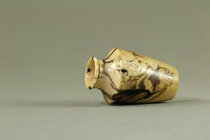
Not much more challenging than punky wood, but can be worth the effort for the spalting!
I've tried soaking with various wood hardeners and finishes but the only thing I found satisfying was thin CA glue. I used several bottles on one bowl, so punky a fingernail would pry out chunks. (Applied in small amounts, repeatedly!)

I never got a picture of that bowl but this little thing was worse! Again, thin CA to the rescue. It was wood I would have otherwise discarded except it had special meaning to a friend. The CA makes the surface so hard it cuts, sands, and finishes well.
1772632212754.jpeg
(Forgot to mention: this is spalted sweetgum.)

JKJ
 
Last edited:
Second batch of cored Sweet Gum, one more batch to go. Will store a boxes of shavings and open 6-8 months later. View attachment 85259

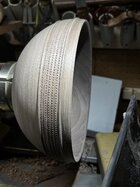

Dang Steve I wish I had not seen these sweet gum bowls. A friend had a huge one taken down and has several big logs laying there. He asked If I wanted them and I said no for the first time turning down free wood. I'm having regrets now. That stuff is beautiful.
 
Working on a prototype for a ring or small jewelry box out of a heart bowl. I just grabbed a couple of scrap pieces of wood, walnut and wenge, to try this style lid. The next lid will be a little wider so the edge meets the side of the heart bowl. The finial is not glued in as I will turn several styles to see what I like.
I’ll then compare and decide which I like and make a few in about 4-5 yeas from now😁.

1772643194666.jpeg

1772643135224.jpeg
 
Back
Top