• The forum upgrades have been completed. These were moderate security fixes from our software vendor and it looks like everything is working well. If you see any problems please post in the Forum Technical Support forum or email us at forum_moderator (at) aawforum.org. Thank you
  • It's time to cast your vote in the February 2026 Turning Challenge. (click here for details)
  • Congratulations to Gabriel Hoff for "Highly Figured Masur Birch Round Bottom Box" being selected as Turning of the Week for March 2, 2026 (click here for details)
  • Welcome new registering member. Your username must be your real First and Last name (for example: John Doe). "Screen names" and "handles" are not allowed and your registration will be deleted if you don't use your real name. Also, do not use all caps nor all lower case.

What’s on your lathe?

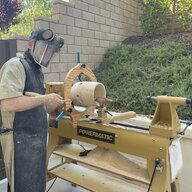
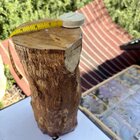
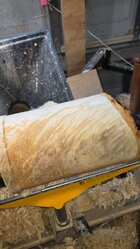
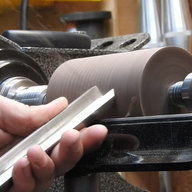
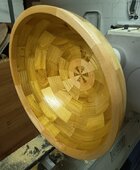
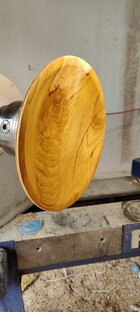
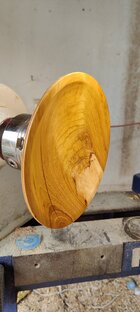
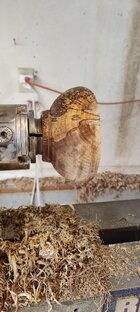
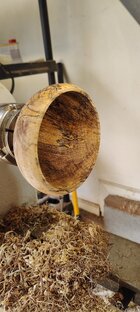
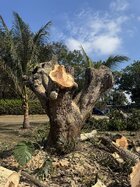
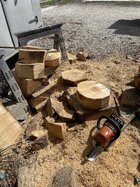
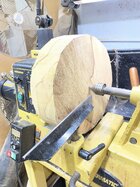
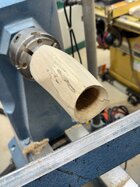
Some mango that was cut down recently. A facebook member on the florida woodworking account put out the location on a massive mango tree that had been cut down and was sitting on the side of the road. Of course they cut it in all the worst ways possible.
I found some great pieces though!
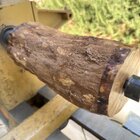
This one is currently sitting wrapped up on my lathe. I'm attempting to decide what direction to go! The bark has stayed in nicely so I'm tempted to include it.
About 13in long x 7in wide right now
 
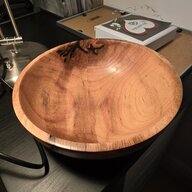
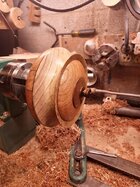
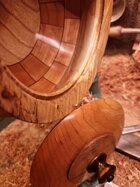
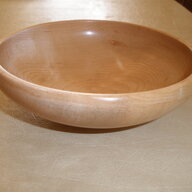
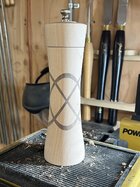
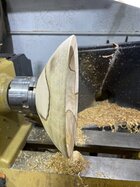
I decided to put splines across the bark inclusion on this butternut crotch bowl. the last time I used splines I just cut a grove across the ark, but I didn't like the look of that method. The groove on this one was plunged all the way through with a 1/2" up cut solid carbide bit. The splines were made from 1/2" X 1 -1/2" butternut with one end rounded over with a 1/2" half round bit, marked for the other end, cut off a little long and cut the other end.
View attachment 85685View attachment 85686
 
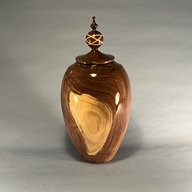
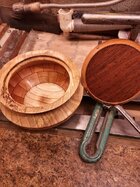
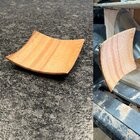
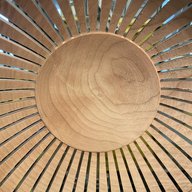
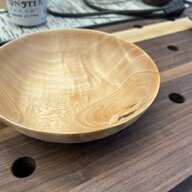
Walnut, 8 x 4.25

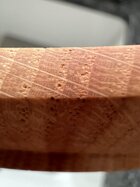
Candy dish with embellishment done with an ebay knurler.

For $12 it'll work (on walnut anyway)
Hi, really interested in what you've achieved using your eBay knurler. The chequered pattern is really good. I've tried one before but with limited success, in fact it was a complete failure to be honest but I may have bought the wrong type. Have you still got the details please.
 
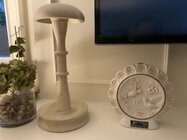
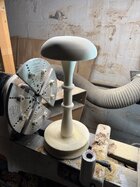
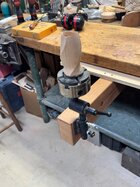
IMG_4838.jpegwell worked on this today, it’s off the lathe now! Our Long Island woodturners association is doing a wig stands for cancer donation to local cancer treatment centers
We were able to uptain a donation of popular wood from local wood suppler
Here’s a look of my first try! Still needs to be stained and finish applied.thinking maybe using some oxolic acid to remove the green so stain will look better?!
 

Attachments

  • IMG_3717.jpeg
    IMG_3717.jpeg
    744.8 KB · Views: 9
I think it is red oak, judging by the red in it. But, I’m no expert.
Wood ID is a bit of a hobby with me.

If you suspect your wood is oak, shave across the end grain of a small scrap with an single-edge razor blade or extremely sharp knife. You don't need to shave a very wide area - just enough to reveal a few rings. All will be revealed.

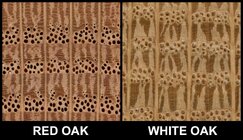
This is what you will see with red vs white oak under low power magnification.
1772977243367.jpeg

These are easily visible with a simple 10x hand lens. I use a low-power stereo microscope in my shop which is easier.

Both red and white oak have fairly wide rays (vertical lines in these photos), distinctive large early wood pores, (at the lower junction of each ring) and what I call distinctive "tornadoes" of latewood pores. Latewood pores are at the top of the visible ring, are generally small in size, and often have distinctive configurations.

Note that large earlywood pores of white oak are filled with what might look like tiny crystals call tyloses; red oak pores are empty. The clogged white oak pores are what makes them good for outdoor furniture and whiskey barrels.

However, Red oak generally has a uniform slightly "redish" color unlike white oak. It doesn't oftan have the red streaks shown in your piece. I see these more in other species, for example Canary wood.

Useful reading is the Wood Database article on identifying wood. The Wood Database also has end grain photos of every species. See section 7.
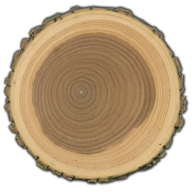
And if you care, note the instructions at the bottom of the article on how to get professional wood ID.

Or better, the book "Identifying Wood" by R. Bruce Hoadley.

Or do what many do, just make up a species name and write it on the bottom. That's how I got started in wood ID - someone passed around a bowl labeled "Cherry" on the bottom. One quick look at an end grain section did not show the diffuse porosity distinctive in all cherry. To avoid loss of respect by those who know, maybe don't write a species name on the bottom! If someone asks, just say "don't know, what do you think!"

JKJ

 
And, @Joel Daniels, another very useful web site is the oddly named HobbithouseInc. Here's there article on Red Oak.

Down the page you'll see a huge number of photos of the various red oak boards. You can check if your piece is consistent with any.

Just for fun, here's there page on Canary wood. Keep in mind again, that with ANY species there will always be a huge variation in what the face grain of a board varies.
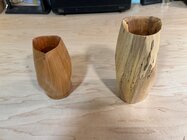
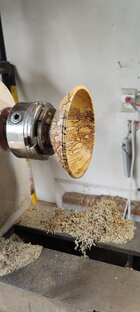
Note there is far more verified info on domestic US species than many "exotics".

JKJ, certified, card-carrying, amateur wood ID wannabe.
 
Note that large earlywood pores of white oak are filled with what might look like tiny crystals call tyloses; red oak pores are empty.

Or do what many do, just make up a species name and write it on the bottom.
@John K Jordan thanks for info. Here’s a closeup pic of the end grain. I think it looks more like red oak but I like your last comment - it’s just oak if anyone asks!
image0.jpeg
 
Hard to tell if there are tyloses in the large earlywood pores without shaving the end grain with a razor blade. All you need is a scrap piece about 1/2" wide, maybe 3/4" long, and deep enough to hold onto. All becomes clear when the sample is prepared cleanly. Some made the mistake of sanding first which obscures things.

I buy single-edged razor blades in packages of 100 for this. An extremely sharp knife may work, or a scalpel (but a scalpel blade is easier to break. Blood spilled on the wood sample doesn't help.

JKJ
 
Back
Top